
Two Agricultural Societies in One Colonial Framework
During the late eighteenth and early nineteenth centuries, Upper and Lower Canada developed distinctly different agricultural systems. Although both colonies existed under British rule following the Battle of the Plains of Abraham in 1759, and relied heavily on farming, their approaches diverged in land layout, farm organization, production strategies and settlement patterns. These differences were shaped by geography, climate, legal traditions, cultural inheritance, and economic orientation. Upper Canada, broadly corresponding to modern Ontario, evolved around British agrarian ideals, while Lower Canada, largely modern Québec, retained a farming system deeply rooted in French colonial practices of settlers who had established themselves in the region before British rule. Understanding why these regions farmed differently offers insight into how environment and culture interact to shape rural economies.
Geographic and Environmental Foundations
The physical landscapes of Upper and Lower Canada played a foundational role in determining how farming systems emerged. Lower Canada was centred along the St. Lawrence River valley, where fertile alluvial soils and reliable water access encouraged linear settlement patterns. In contrast, Upper Canada consisted of a larger inland territory characterized by mixed forest cover, variable soils, and extensive interior waterways, including the Great Lakes.
READ: How Much of Canada Is Actually Farmland?
Lower Canada’s agricultural heartland benefited from centuries of gradual soil enrichment and a relatively stable microclimate along the river corridor. This allowed farms to be smaller, intensively cultivated and oriented toward subsistence with modest surplus production. Upper Canada, however, required large-scale forest clearing before cultivation could begin. The physical challenge of transforming woodland into arable land favoured larger holdings, extensive production methods and a more expansionist farming mentality.
Seigneurial Land System and Its Agricultural Impact in Lower Canada
One of the most defining differences in farming design between the two colonies was the land tenure system. Lower Canada retained the seigneurial system inherited from New France, under which land was divided into long, narrow strips extending back from the river. This arrangement ensured equal access to transportation, water, and fertile soil, reinforcing a communal approach to settlement.
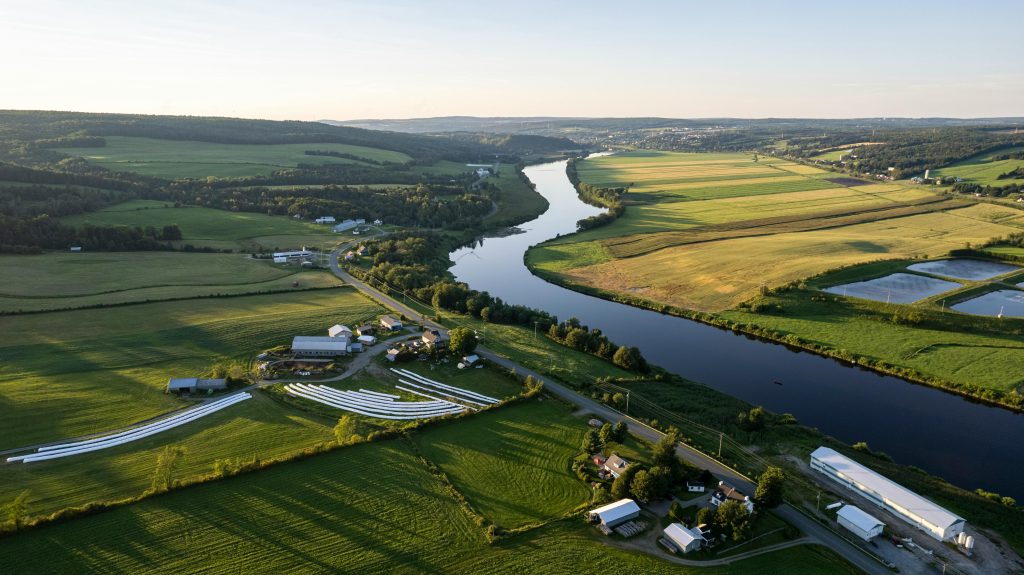
Farm organisation under this system was shaped by social obligations rather than purely economic calculation. Les habitants, as these French settlers came to be called, typically farmed relatively small plots, focusing on crop diversity to manage risk and meet household needs. Fields were laid out for practicality rather than mechanization, and agricultural practices emphasized continuity and stability over innovation. This led to a farming strategy that prioritized food security, community cohesion and long-term land use rather than rapid commercial expansion.
Freehold Tenure and British Agrarian Ideals in Upper Canada
Upper Canada adopted British freehold land tenure, which encouraged individual ownership, land accumulation, and speculative settlement. Farms were surveyed in rectangular concessions and lots, creating a grid system that differed dramatically from the linear river-based layouts of Lower Canada. This design reflected British notions of rational land use and administrative efficiency.
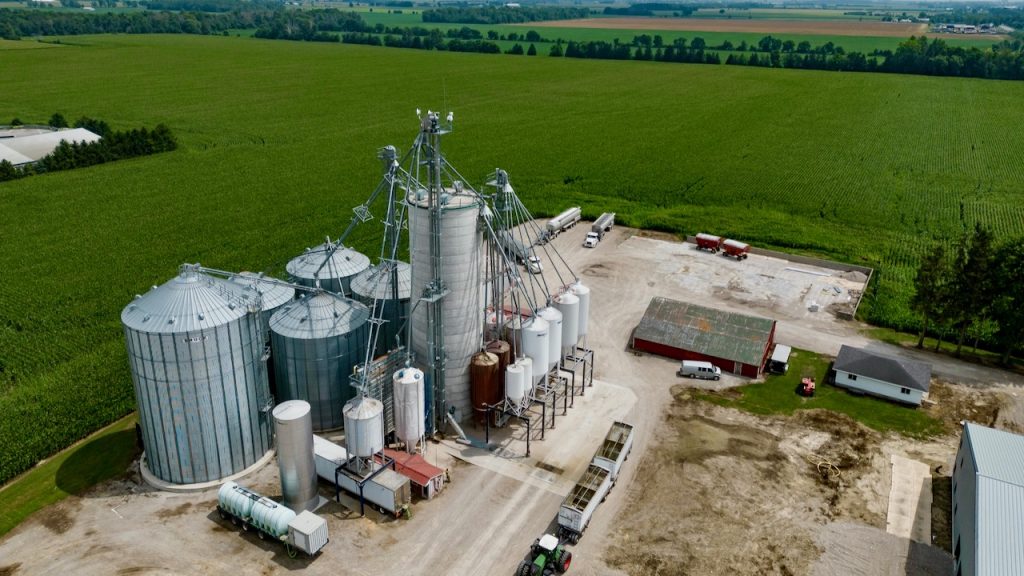
Because land was more abundant, Upper Canadian farms were generally larger and less densely settled. Farming strategies focused on clearing land quickly and expanding production, particularly of cereal crops such as wheat. The emphasis on private ownership encouraged entrepreneurial decision-making and experimentation, which in turn led to earlier adoption of new tools, crop varieties, and market-oriented practices.
Agricultural Organisation and Labour Structures
Labour organization differed significantly between the two colonies. In Lower Canada, farming relied heavily on family labour supplemented by seasonal communal work. Traditional practices, such as shared harvesting and reciprocal assistance reinforced social ties and limited the need for hired labour. The agricultural calendar followed established routines passed down through generations, and innovation occurred slowly.
READ: Why Rice Remains the Backbone of Bangladesh’s Rural Economy
Upper Canada, by contrast, increasingly relied on hired labour as farms expanded. Seasonal workers, recent immigrants and neighbours were often employed during peak periods, such as clearing, planting, and harvest. This flexibility allowed farms to grow larger and operate more intensively, but it also introduced a more commercial and transactional approach to agriculture. Labour became a cost to be managed rather than a fixed component of family life.
Crop Selection and Farming Strategies
Lower Canada’s farming strategy was shaped by risk aversion and subsistence needs. Mixed farming predominated, with wheat, oats, peas and vegetables grown alongside small-scale livestock husbandry. Diversification helped households withstand poor harvests, price fluctuations, and environmental stress. While wheat was important, it was not always the sole focus, and soil exhaustion from repeated cereal cropping eventually limited productivity.
Upper Canada’s agriculture developed with a stronger export orientation. Wheat became the dominant crop, driven by demand from British, and Atlantic markets. This specialization allowed farmers to generate cash income and integrate into global trade networks, but it also made them more vulnerable to market volatility, and soil depletion. Over time, crop rotation and livestock integration expanded as farmers responded to declining yields, and changing economic conditions.
Location, Transportation and Market Access
Settlement location strongly influenced agricultural organization in both regions. In Lower Canada, farms clustered along rivers not only for fertile soil, but also for transportation. The St. Lawrence River functioned as the main commercial artery, allowing surplus produce to reach local and international markets with relative ease. This reinforced compact settlement and limited inland expansion.
Upper Canada’s farms were often located far from major markets during the early period of settlement. Poor road infrastructure and long distances increased transportation costs and encouraged self-sufficiency in the initial stages. As canals, roads and ports developed however, Upper Canada’s interior farms became increasingly connected to urban centres and export routes, reinforcing commercial agriculture and encouraging further settlement away from waterways.
Cultural Attitudes Toward Land and Improvement
Cultural values also shaped farming decisions. In Lower Canada, land was viewed as a family inheritance to be preserved and subdivided among descendants. This encouraged conservative management, and resistance to major structural change. Agricultural improvement was often incremental, balancing tradition with necessity.
READ: The Long Rise of California’s Almond Industry
In Upper Canada, land was more commonly seen as a commodity and a vehicle for economic advancement. Clearing land, improving yields, and expanding acreage were markers of success. This mindset encouraged experimentation and adaptation, as well as greater acceptance of agricultural reform movements and new farming techniques introduced from Britain, and the United States.
Long-Term Agricultural Outcomes
By the mid-nineteenth century, these differing approaches produced contrasting rural landscapes. Lower Canada remained characterized by dense riverfront settlements, small mixed farms and strong community networks. Agricultural productivity was stable but limited, contributing to demographic pressure, and outward migration in later decades.
Upper Canada evolved into a region of larger farms, dispersed settlement, and increasing mechanization. Its agriculture became more integrated into global markets, laying the foundation for Ontario’s later role as a major agricultural producer. However, this growth came with environmental costs, including soil degradation and deforestation, which required subsequent adaptation.
Divergence Rooted in Place and People
The differences in farming design, organization, strategy and location between Upper Canada and Lower Canada were not accidental. They emerged from a complex interaction of geography, legal systems, cultural traditions, and economic goals.
In Québec, the legacy of the seigneurial, river-oriented farming system is still visible in the province’s rural geography. Agricultural communities remain tightly concentrated along the St. Lawrence River and its tributaries, where long-established farm families continue to operate relatively small holdings. Many modern Québec farms prioritize diversified production such as dairy, fodder crops, and mixed agriculture rather than large-scale monocropping. This reflects a historical emphasis on continuity and risk management rather than rapid expansion. Land subdivision patterns, inheritance practices and zoning regulations in many rural parishes still favour preservation of family farms over consolidation, reinforcing a landscape of closely spaced communities with strong local identities.
Ontario’s agricultural landscape reflects a contrasting inheritance from Upper Canada’s freehold, expansion-driven model. Farms are typically larger, more dispersed and oriented toward regional, and global markets. The prevalence of large-scale grain, oilseed and cash-crop operations reflects a long-standing comfort with land consolidation, and commercial specialization. Ontario’s rectilinear road grids, concession lines and farm boundaries are direct descendants of the original survey system, shaping everything from transportation planning to modern drainage infrastructure. The province’s agricultural sector has also been quicker to adopt mechanization, precision farming and export-oriented strategies, continuing a historical pattern of viewing land as an asset to be improved, reorganized, and scaled.
At a policy level, these historical differences also influence how each province approaches agricultural regulation, and rural development. Québec has placed greater emphasis on supply management, land protection and limits on non-agricultural land use, aligning with a tradition of safeguarding farming as a cultural, and social foundation. Ontario, while also protecting agricultural land, has historically allowed greater flexibility for land aggregation, innovation and diversification into agri-business, food processing, and export logistics. These policy tendencies reflect deeply rooted differences in how land, labour, and production were originally organized.
Together, these two agricultural systems illustrate how colonial societies, even under shared political authority, can develop profoundly different rural economies. Their legacies continue to shape the agricultural landscapes of Québec and Ontario today, revealing how historical choices about land, labour and location can influence regional development for generations.
Québec protected small family farms through law and culture; Ontario scaled up for global markets — as agriculture faces climate and economic pressures, which model do you think is better built for the future?