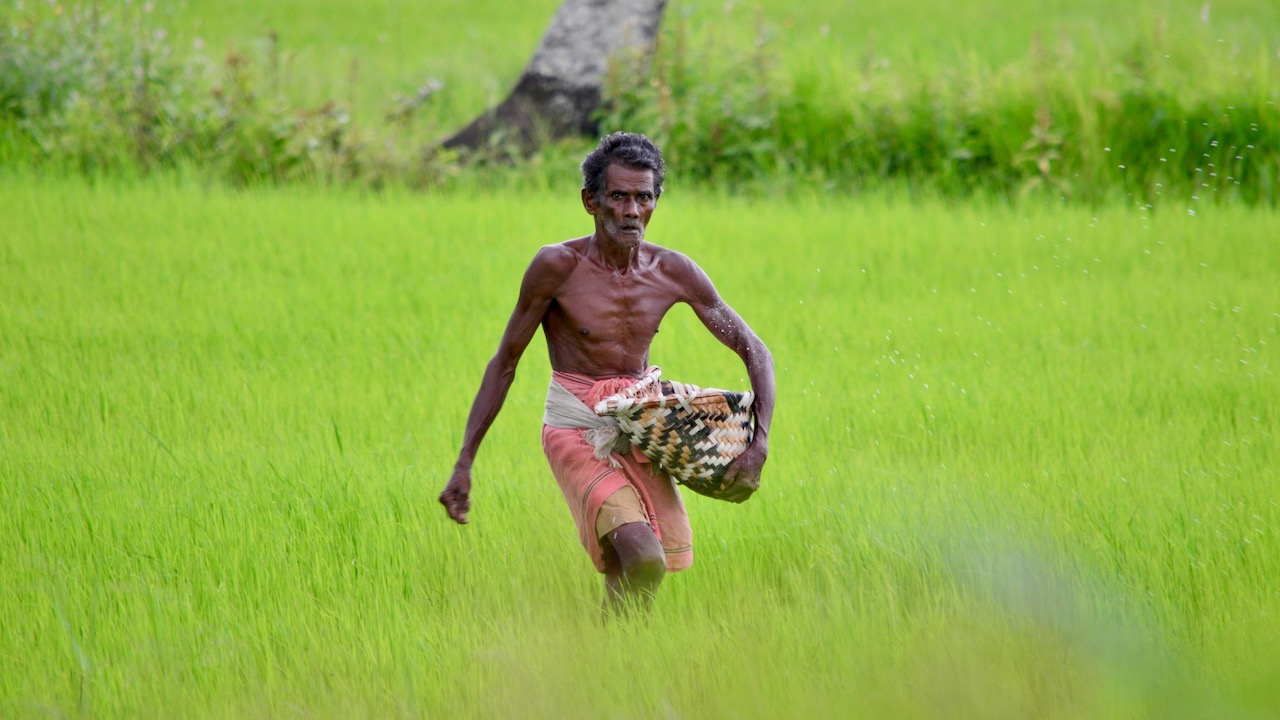
India’s agricultural landscape is vast and diverse, and at its heart is rice, a staple that not only feeds hundreds of millions domestically, but also supplies global markets. In January 2026, India’s Minister of Agriculture and Farmers Welfare, Shivraj Singh Chouhan announced that the country had officially overtaken China to become the world’s largest rice producer, a remarkable achievement with significant implications for food security, and international trade.
India’s Rise to the Top in Global Rice Production
India has a long and transformative history in rice agriculture, evolving from scarcity to global dominance in production. India’s total land mass is roughly 852 million hectares (about 3.29 million square miles). According to a Government of India press release in 2024, the total amount of land used for agriculture is approximately 180 million hectares, which is about 21 percent of the country’s total land area.
In the early years, after India’s independence in 1947, rice production was modest by today’s standards. For instance, in the 1950–51 agricultural year, rice output was around 20 million tonnes, a level that only marginally increased through the 1950s as traditional farming methods and limited irrigation constrained productivity.
READ: Why Rice Remains the Backbone of Bangladesh’s Rural Economy
Challenges in food availability in the 1950s and early 1960s led India to import cereals to meet domestic demand. However, beginning in the mid-1960s, the introduction of high-yielding varieties (HYV) of rice as part of the Green Revolution, coupled with improved irrigation, fertilizer use and agricultural extension services — for example, demonstration plots and field trials, farmer training and advisory visits, mass communication programs — helped drive unprecedented growth in production. Over the following decades, India increased rice output many times over, transforming itself from a net importer to a self-sufficient producer and, by the early 21st century, a major exporter of rice.
What were the high-yielding varities?
The most significant early varieties included:
IR8
Developed by the International Rice Research Institute (IRRI) in the Philippines and released in 1966, IR8 was one of the first semi-dwarf, fertilizer-responsive rice varieties. It produced substantially higher yields than traditional tall varieties when supplied with irrigation, and chemical fertilizers. It became widely known as the “miracle rice”.
Jaya
An Indian variety developed from IR8 derivatives by the Indian Agricultural Research Institute (IARI). Released in 1968, Jaya was better suited to Indian agro-climatic conditions and became one of the most widely cultivated HYVs in the early Green Revolution years.
Padma
Another improved semi-dwarf variety released in the late 1960s, also derived from IRRI breeding material and adapted for Indian conditions.
IR20
Introduced in the early 1970s, IR20 offered improved disease resistance and stable yields, particularly in southern India.
These varieties shared common characteristics: shorter plant height (reducing lodging — bending or breaking of the stalk), strong response to nitrogen fertilizer, shorter growing cycles, and higher grain output per hectare compared to traditional indigenous varieties. Their success depended heavily on parallel expansion in irrigation infrastructure, fertilizer availability, and government procurement policies.
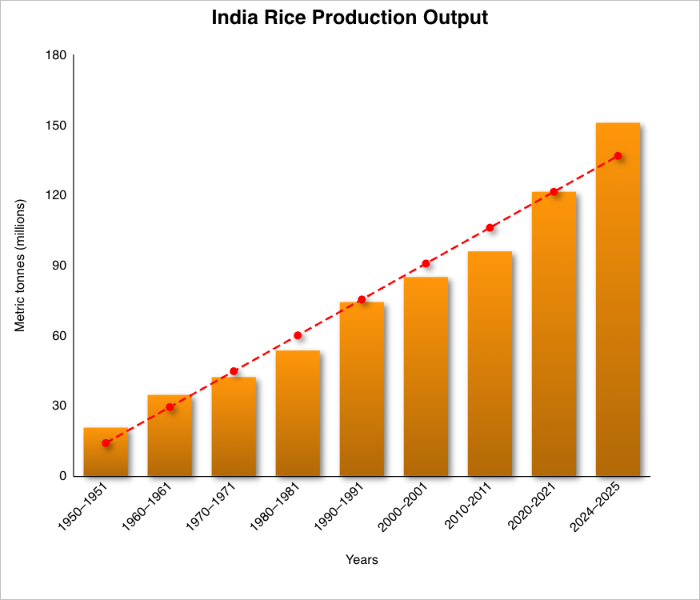
In the 2024–25 agricultural year, India’s rice output surged to around 151 million metric tonnes. This milestone reflects decades of agricultural development, improved seed varieties, enhanced irrigation, and government support mechanisms, such as the Minimum Support Price (MSP) — a guaranteed price designed to protect rice (paddy) farmers from market price crashes, especially during bumper harvests — ensuring they receive a remunerative, pre-announced price. Rice now accounts for a significant share of the country’s agricultural output, underpinning food availability, and forming a cornerstone of rural livelihoods.
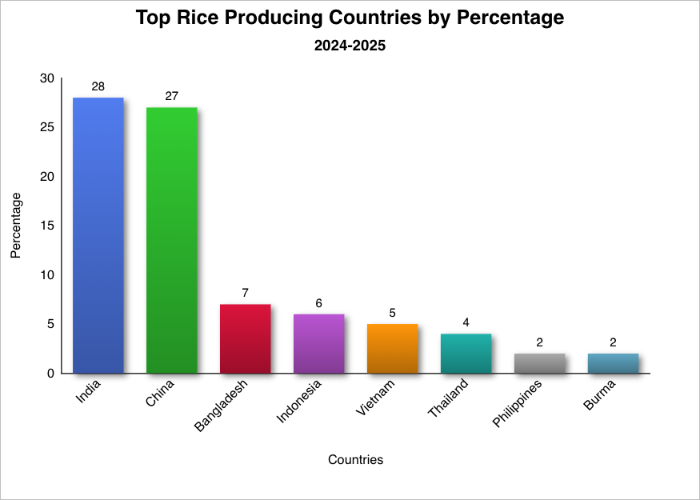
India’s contribution to global rice production is substantial, with recent estimates suggesting it accounts for more than a quarter of all rice produced worldwide. While domestic consumption remains large given India’s population, the surplus output supports a thriving export sector.
Seasons and Types of Rice in India
Rice cultivation in India follows distinct seasonal cycles, shaped largely by climatic patterns and monsoon rains.
Kharif (Southwest Monsoon)
The main kharif season runs from June to October, coinciding with the southwest monsoon. Most rice cultivation in India occurs during this season because the abundant rainfall supports the water-intensive nature of paddy fields.
Rabi (Winter Season)
Rabi rice is cultivated from around November to March, primarily in regions with assured irrigation rather than reliance on monsoon rainfall. This crop is common in eastern and southern India, where canal systems, tube wells, and reservoirs support winter planting. Although smaller in scale than kharif production, rabi rice contributes meaningfully to overall annual output in irrigated districts.
Summer (Pre-Monsoon Season)
Summer rice, often grown between March and June, depends almost entirely on controlled irrigation and favourable local conditions. It is concentrated in select pockets of eastern and southern states where water availability permits short-duration varieties to mature before the onset of the southwest monsoon. While comparatively limited in acreage, summer cultivation allows farmers to maximize land use across the agricultural calendar.
Other types of rice
Like neighbouring Bangladesh, India also boasts a rich diversity of rice types, from fragrant basmati to non-basmati and parboiled varieties. Basmati rice, known for its aroma and long grains, is a premium export product, cultivated primarily in northern states such as Punjab, Haryana and parts of Uttar Pradesh. Non-basmati varieties dominate general food consumption and are widely grown across the eastern and southern plains.
Export Markets: More for the World
India is not just a leading producer of rice, it is also the world’s largest exporter. For many years India has held a large share of global rice trade, accounting for almost 40 percent of total rice exports. In the 2024–2025 period, rice exports reached levels that rivalled historical records, with shipments going to more than 170 countries worldwide.
READ: Why Are Used Tractors So Expensive?
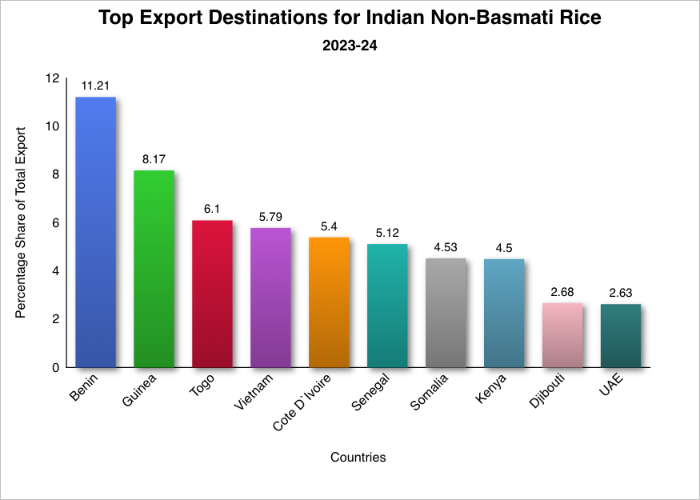
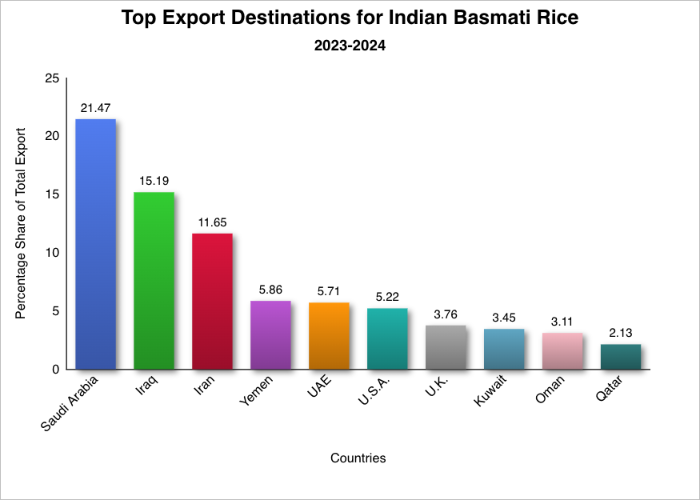
Exports include both non-basmati and basmati rice, with markets in Africa, the Middle East, and Southeast Asia forming significant destinations. Non-basmati white rice, broken rice, and processed parboiled rice are especially important in regions where affordability and bulk shipments matter, while premium basmati rice commands higher prices in markets such as Europe and the Middle East.
While India’s domestic consumption is high, the substantial surplus created by strong production underpins its export capabilities. Exports are economically significant, contributing billions of dollars in foreign exchange earnings and supporting thousands of jobs in milling, logistics, and trade.
Farm Ownership and Agricultural Structure
India’s rice production is overwhelmingly driven by smallholder and family farms rather than large corporate estates. Most farms growing rice are owned and operated by individual farmers or their families, often on holdings of a few hectares or less. These agricultural communities work with local cooperatives, farmer producer organizations (FPOs) and regional millers to access markets, and services.
READ: How Much of Canada Is Actually Farmland?
While corporate entities and agribusinesses play a role in rice processing, milling, research, and export logistics, the ownership of cultivated land remains decentralized. Government policies tend to support small and marginal farmers through price assurances, input subsidies, and procurement programs, such as the MSP system.
There has also been growing involvement of private sector partners in areas such as seed development, mechanization, and contract farming arrangements. However, the core production remains rooted in traditional farm ownership structures that characterize Indian agriculture.
Regional Dominance and Diversity
Rice is grown across many parts of India, but certain regions are particularly significant.
The northern plains — especially states like Punjab, Haryana, Uttar Pradesh and Bihar — are major producers of high-yielding rice varieties and basmati rice. These areas benefit from fertile alluvial soils and extensive irrigation.
The eastern states — including West Bengal, Odisha, Jharkhand, and parts of the northeastern region — are crucial for non-basmati rice production. In West Bengal in particular, rice cultivation is deeply embedded in local diets, and agricultural culture.
Southern states such as Andhra Pradesh, Telangana, Tamil Nadu, and Karnataka also contribute significantly, especially under irrigated conditions. Across these regions, agro-ecological diversity supports a range of rice varieties suited to different tastes, textures, and market demands.
Recent Policy Changes: Impact on the Rice Sector
Policy in India’s rice sector has been dynamic, reflecting the need to balance domestic food security with export opportunities.
One major trend in recent years has been the deregulation of rice exports. Restrictions and bans that were introduced during periods of supply concern have generally been eased as production strengthened. For example, after imposing export curbs in 2022 and subsequent years to secure domestic stocks, the Indian government progressively lifted these constraints, removing duties, and minimum export prices to stimulate trade.
READ: The Long Rise of California’s Almond Industry
The removal of the ban on exports of de-oiled rice bran in late 2025 marked another shift that supports associated industries, such as animal feed, and oil extraction. The resumption of exports is expected to improve profitability for millers, and balance supply within domestic markets.
The MSP system continues to be central to domestic agricultural policy, providing a price floor for paddy that encourages production stability. Questions about diversification away from water-intensive paddy cultivation have influenced policy discussions, with incentives now being introduced to encourage farmers to consider alternative crops where feasible. This reflects growing awareness of environmental, and resource sustainability concerns.
Moreover, India’s engagement in international trade negotiations continue to affect agricultural markets. Recent trade negotiations between India and the United States have centred on an interim trade framework and broader bilateral trade agreement talks that were formalized in early 2026. Under this framework, the two countries agreed to reduce and, in some cases, eliminate tariffs on a range of goods to facilitate expanded market access, and strengthen economic ties. The interim deal stems from talks launched in 2025 between Prime Minister Narendra Modi and President Donald Trump, with the aim of progressing toward a full U.S.–India Bilateral Trade Agreement.
One of the key outcomes of this interim framework is that the United States agreed to lower the tariff rate on many Indian exports, reducing them to 18 percent, down from previously much higher rates on certain items, and eliminating tariffs entirely on specific sectors.
READ: Saudi Arabia, the Desert Kingdom that Decided to Feed Itself
On the agricultural side, the Indian government agreed to reduce or eliminate import duties on selected U.S. food and agricultural products, including items like distillers dried grains with solubles (DDGS), red sorghum for animal feed, tree nuts, soybean oil, and some fresh and processed fruits. These concessions represent a calibrated opening of India’s agricultural market for certain American products.
However, the interim framework also includes protective provisions: India has deliberately excluded many sensitive staple commodities from tariff concessions. Products such as rice, wheat, maize (corn), dairy, poultry, ethanol, and several vegetables remain fully protected with no duty relief or lowered tariffs under the current agreement. These exclusions are intended to safeguard rural livelihoods and domestic farming sectors.
This combination of reduced tariffs for exporters and selective protection for sensitive crops has generated debate within India. Some farmers’ organizations and union groups have expressed concern that even limited tariff concessions on certain U.S. agricultural imports could exert downward pressure on domestic crop prices or disrupt livestock feed markets, while government officials emphasize that core staple sectors remain protected, and that expanded market access supports export growth.
Opportunities and Challenges Ahead
India’s leadership in rice production and trade brings both opportunities and responsibilities. On the positive side, strong output supports food security, export earnings, and global supply chains. The variety of rice types grown in the country also caters to diverse culinary, and market preferences across continents.
However, challenges remain. Rice is water-intensive, and reliance on paddy cultivation can strain water resources in parts of India. Ensuring sustainable irrigation, improving storage infrastructure to reduce post-harvest losses, and promoting crop diversification are ongoing policy priorities.
The interplay between domestic food needs and international trade will continue to shape how India manages its rice sector. Balancing security with competitiveness requires nuanced policy approaches, investment in research and extension services, and support for the smallholder farmers who are the backbone of this vital agricultural sector.
The Future of India’s Global Rice Dominance
India’s emergence as the world’s largest rice producer and leading exporter marks a significant milestone in global agriculture. According to a United States Department of Agriculture (USDA) report published in January 2026, India’s rice production outlook is expected to hover around 152 million tonnes for the 2025-2026 period. Through a combination of favourable monsoon seasons, policy support, market diversification, and farmer resilience, it has carved out an influential role in feeding both its own population, and consumers worldwide. As the industry evolves, attention to sustainability, equitable growth, and responsive policy will be crucial in maintaining this position into the future.
Rice feeds more than half the world’s population — is it underrated as a global strategic resource compared to oil, wheat, or other commodities we hear more about?
Sources
- Abadam, V., Sowell, A., Bond, J., & USDA, Economic Research Service. (2026). Rice Outlook: January 2026. In United States Department of Agriculture. Retrieved March 15, 2026, from https://ers.usda.gov/sites/default/files/_laserfiche/outlooks/113673/RCS-26A.pdf
- Agricultural Statistics at a Glance 2015, Ministry of Agriculture & PRS. (2026). Analytical Reports – State of Agriculture in India. PRS Legislative Research. Retrieved March 15, 2026, from https://prsindia.org/policy/analytical-reports/state-agriculture-india
- Directorate General of Commercial Intelligence & Statistics, Kolkata. (2024). A brief report on export of rice by India. In Government of India Ministry of Commerce and Industry Directorate General of Commercial Intelligence and Statistics. Government of India. Retrieved March 15, 2026, from https://www.dgciskol.gov.in/writereaddata/Downloads/20240808163758A%20brief%20report%20on%20Export%20of%20Rice%20by%20India.pdf
- Directorate of Economics and Statistics, Ministry of Agriculture & Farmers Welfare, Govt. of India. (2019). Table 5.7: All India area, production and yield of Rice. In Indian Agricultural Statistics Research Institute. Retrieved March 15, 2026, from https://iasri.res.in/agridata/23data/chapter5/db2020tb5_7.pdf
- EconomyWatch. (2021, May 18). All-India Area, Production and Yield of Rice from 1950 to 2000. Economy Watch. Retrieved March 15, 2026, from https://www.economywatch.com/all-india-area-production-and-yield-of-rice-from-1950-to-2000
- ET Online. (2026, January 6). Budget 2026: Rice exporters seek support to offset impact of rising cost, environmental stress. The Economic Times. Retrieved March 15, 2026, from https://economictimes.indiatimes.com/news/economy/agriculture/budget-2026-union-budget-2026-india-budget-india-rice-exporters-union-budget-of-india-budget-news-2026-budget/articleshow/126368513.cms
- High Commission of India, Colombo, Sri Lanka. (2026). Fact Sheet – India | High Commission of India, Colombo, Sri Lanka. Retrieved March 15, 2026, from https://www.hcicolombo.gov.in/page/fact-sheet-india/
- Jayanti, K., & Kumar, P. (2019). Productivity of aerobic rice hybrid under varying plant density: A review. International Journal of Chemical Studies, 169–176. https://www.chemijournal.com/archives/2019/vol7issue6/PartE/SP-7-6-38-397.pdf
- Kotkiewicz, J. (2026, February 10). FACT SHEET: The United States and India announce historic trade deal. The White House. Retrieved March 15, 2026, from https://www.whitehouse.gov/fact-sheets/2026/02/fact-sheet-the-united-states-and-india-announce-historic-trade-deal/
- PIB Delhi. (2021, May 25). Ministry of Agriculture and Farmers Welfare releases Third Advance Estimates of Principal Crops for 2020-21. Retrieved March 15, 2026, from https://www.pib.gov.in/PressReleaseIframePage.aspx?PRID=1721692®=3&lang=2
- Singh, S. K. (2025). Grain and Feed Update. In United States Department of Agriculture. United States Department of Agriculture. Retrieved March 15, 2026, from https://apps.fas.usda.gov/newgainapi/api/Report/DownloadReportByFileName?fileName=Grain%20and%20Feed%20Update_New%20Delhi_India_IN2025-0070.pdf
- The Hindu Bureau. (2026, January 5). India has overtaken China in rice production, says Agriculture Minister Shivraj Singh Chouhan. The Hindu. Retrieved March 15, 2026, from https://www.thehindu.com/news/national/congress-misinformation-vb-gramg-better-scheme-than-mgnrega-centre-unveils-seed-varieties-shivraj-singh-chouhan/article70471213.ece
- Total cropped area increases from 201.18 million hectares to 219.16 million hectares. (2024, July 30). Ministry of Agriculture & Farmers Welfare. Retrieved March 15, 2026, from https://www.pib.gov.in/PressReleaseIframePage.aspx?PRID=2039218®=3&lang=2
- United States Department of Agriculture. (2025). Production – Rice. In United States Department of Agriculture. Retrieved March 15, 2026, from https://www.fas.usda.gov/data/production/0422110