The Canadian dairy industry has long been a defining part of the nation’s agricultural economy, shaped by policy decisions that continue to spark debate. At its heart lies supply management, a system of production quotas, regulated farm-level pricing and tariff protections designed to stabilize the supply and price of dairy domestically. But as inflation, trade pressures and global market trends evolve, one may ask whether this government-backed structure remains appropriate or whether deregulation — moving to a more market-oriented system — would benefit producers, consumers and the broader economy.
A Brief History of the Canadian Dairy Sector
Canada’s journey toward supply management began in the mid-20th century, as dairy producers in Québec and Ontario faced volatile prices and chronic oversupply in the 1950s and 1960s. Milk production was fragmented and noticeably price-sensitive to market swings, often leaving farmers with low, unstable incomes. In response, provincial marketing boards were formed to regulate production, control prices and coordinate sales. In 1966, the federal government established the Canadian Dairy Commission (CDC) to set support prices and manage the industry nationally, creating a framework that would become part of the national supply management system established in the early 1970s.
READ: The Evolution of Agriculture in Puerto Rico: History, Exports and Modern Realities
Under supply management, production quotas known as Market Sharing Quotas (MSQs) were introduced to match supply with domestic demand, while provincial boards, such as the Dairy Farmers of Ontario (DFO) or Les Producteurs de Lait du Québec set prices paid to producers and regulated fluid milk markets. These quotas effectively limited how much milk each producer could sell, with the Canadian system designed to prevent oversupply and stabilize incomes.
The Dairy Farmers of Canada (DFC), founded in 1934 as a national advocacy and promotional organization, now represents a little over nine thousand dairy farm owners and serves as a powerful voice in policy debates and trade negotiations.
Ontario and Québec: Powerhouses of Production
Milk production in Canada is highly concentrated geographically. Québec and Ontario are the leading dairy producers by a significant margin. Together, these two provinces account for over 80 percent of all Canadian dairy farms, with Québec alone housing nearly half of all producers. The industry in these regions represents a substantial economic footprint, supporting jobs and contributing to regional agricultural output.
Despite this importance, the supply management system has shaped not only production, but also access to the industry for newcomers.
The Costs of Starting Up: High Barriers to Entry
One of the most persistent criticisms of Canada’s dairy policy is the barrier to entry posed by quota costs. MSQs, initially handed out for free decades ago, have since accumulated significant market value. By 2018, the total value of quota across Canada was estimated at over $35 billion, with individual quota units selling for tens of thousands of dollars per kilogram of butterfat.
In practical terms, this means that a new dairy farmer faces staggering initial costs simply to enter the industry. Milk quota alone can represent a substantial portion of startup costs, creating a situation where prospective farmers must secure significant capital or debt before they can even begin producing milk. Banks may lend against quota, but the high collateral requirement further raises financial risk. These conditions have been cited as having an exclusionary effect on young producers and newcomers, effectively restricting industry growth to those with substantial initial resources and individuals who inherited the family legacy over generations.
Beyond quota, additional costs such as farmland acquisition, barns, milking equipment and compliance with rigorous regulatory standards add layers of financial burden that discourage new entrants. The result is a dairy sector with high average farm age and limited new investment, factors that are central to the ongoing debate about deregulation.
What Does it Actually Cost to Become a Dairy Farmer in Canada?
The following is a rough example of what it would cost to start a dairy business in Ontario, with assistance from the Dairy Farmers of Ontario New Entrant Quota Assistance Program (NEQAP).
Under NEQAP, 20 kilograms of butterfat quota is loaned at zero upfront cost and zero interest over the program’s term. For context, the total milk quota in 2024/2025 for all of Canada was roughly 422 million kilograms of butterfat.
READ: Why 99 Percent of Canadians Are Denied Entry into Farming
If the prospective farmer needs more quota beyond the loaned amount, additional quota must be purchased on the open market at a capped price of $24,000 per kilogram of butterfat.
For example, if a farmer wants 30 kg of butterfat quota from the outset:
10 kg × $24,000 = $240,000 (cost above NEQAP)
A typical dairy cow produces between 20 and 40 litres per day. Let’s assume an average of 30 litres per day.
Butterfat quota is measured in kilograms of butterfat per day. A Holstein cow producing 30 litres of milk, assuming roughly 4 percent butterfat, produces approximately:
30 litres × 4 percent = 1.2 kg butterfat per day per cow
To fill 20 kg of butterfat quota:
20 kg ÷ 1.2 kg of butterfat per cow = roughly 17 cows
For safety and production variability, most farmers would likely need 18–20 cows to reliably fill 20 kg.
A good dairy cow in Ontario can cost approximately $2,500–$3,500 depending on genetics and stage of lactation. Using $3,000 per cow as a reasonable planning estimate:
20 cows × $3,000 = $60,000
A 600 kg dairy cow may consume approximately 29 kg of feed dry matter per day, depending on its production level and diet.
29 kg × 20 cows = 580 kg of feed per day
580 kg × 365 days = 211,700 kg of feed per year (211.7 tonnes)
If the feed is valued at roughly $350 per tonne:
211.7 tonnes × $350 = $74,095 per year in feed costs
Milk Production Potential:
20 cows × 30 litres per day = 600 litres per day
600 litres × 365 days = 219,000 litres per year
Illustrative Gross Revenue:
To make this concrete, let’s use a simplified example with a middle-of-the-range figure.
For illustration, if we assume the farm receives $90 per hectolitre of milk sold to processors, this translates to:
$90 per hectolitre ÷ 100 litres = $0.90 per litre delivered by the farm
20 cows producing roughly 600 litres per day:
600 litres per day × $0.90 per litre = $540 per day in gross revenue
Annualizing that figure:
$540 × 365 days = $197,100 in gross annual revenue from milk sold at farmgate prices
Additional Expenses:
Barn and infrastructure, milking system (pipeline or robotic, depending on scale), milk bulk tank, manure management system, equipment (tractor, feed mixer, skid steer etc.).
A conservative estimate for a small starter dairy facility:
Barn construction: $250,000–$500,000
- $12,000-$15,000 per stall
Milking system, tank, robots etc.: $100,000–$250,000
- Bulk tank: $25,000–$60,000 (less for used, smaller ones)
- Pipeline milking system: $40,000–$80,000
- Installation and electrical: $15,000–$30,000
- One robotic unit approximately $100,000–$300,000
Basic equipment: $100,000+
- Tractor – $40,000–$80,000+ (used vs. new)
- Skid steer – $25,000–$50,000
- Feed mixer or wagon – $25,000–$60,000 (may be less for smaller operation)
- Manure equipment costs are highly variable – $8,000+
Depending on the scale and specifications, this venture could approach or exceed $1,000,000 in infrastructure costs before land is even considered.
Land Costs:
Ontario farmland prices vary widely by region. Productive dairy land can easily exceed $20,000 per acre in many areas. For instance, in 2024, the cost of an acre of farmland in Southwestern Ontario was $33,700. We’ll use $20,000 in this example.
If a farmer needs 50 acres (to grow feed as well):
50 acres × $20,000 = $1,000,000
Some farmers may rent land instead, but purchasing dramatically increases startup costs.
The very basic scenario:
Loaned 20 kg of butterfat quota: $0
Cows: $60,000
Infrastructure: $750,000 (mid-range estimate)
Land (50 acres purchase): $1,000,000
Estimated startup total:
$1.81 million (before working capital).
Estimated startup total for 30 kg of butterfat quota:
$1.81 million
$240,000 (10 kg purchased in the open market)
= $2,050,000 (before working capital)
And that does not include:
- Operating cash reserves
- Insurance
- Utilities (water, electricity etc.)
- Labour (if hiring help)
- Veterinary services
- Debt interest
The new farmer gradually loses production capacity unless they purchase quota to replace the initial loan, which they’ll have to do in order to maintain the business.
And in year 11, repaying the loan (set at 1.2 kg of butterfat per year under this example) would look like this:
1.2 kg ÷ 1.2 kg per cow = 1 cow = 30L/day
Annual revenue reduction:
30 × 0.90 = $27/day × 365 = $9,855 per year
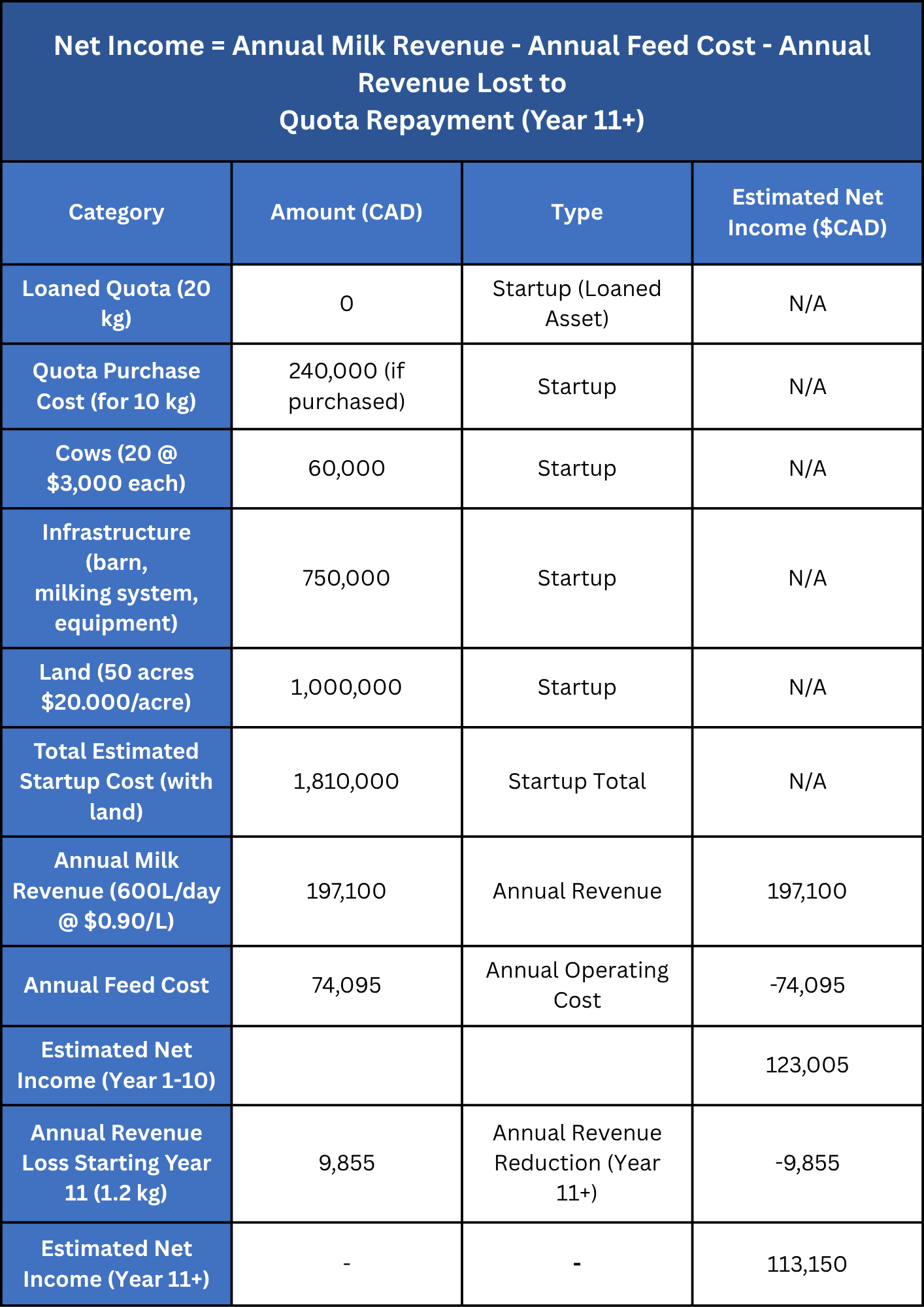
The new farmer would ultimately need to purchase quota to replace the loaned quota as it is gradually repaid, potentially requiring up to 20 kg at the current capped price of $24,000 per kilogram, or $480,000. The above table is just for illustrative purposes to demonstrate the approximate value 20 kg would generate with only feed cost factored in (and paying back the loan on year 11), not a true net income when all other operational costs are added, which would be significant. The hard truth is that without millions of dollars, some sort of partnership, or inherited quota, it is extremely rare for new entrants to enter the industry. It just doesn’t happen.
Comparing International Models: United States and Australia
To understand the Canadian debate in context, it is essential to contrast how other countries approach dairy production.
In the United States, the dairy industry operates without supply management. There is no national quota system restricting production based on domestic demand. Instead, producers sell into a largely market-driven environment, although safety-net programs did exist. For example, the U.S. previously had a Dairy Price Support Program which indirectly supported milk prices, but was eliminated in 2014. Market forces dictate production volumes and prices and producers often respond to global commodity signals.
Milk prices in the U.S. are generally lower at the retail level than in Canada. A study from 2019 comparing milk prices across 15 cities found that, on average, milk in Canada was about 29 percent more expensive per litre than in the U.S., even after adjusting for currencies and container sizes.
READ: How Much of Canada Is Actually Farmland?
More recent data suggest that the price gap has persisted beyond that 2019 comparison. According to 2024 retail price figures compiled using data from the U.S. Bureau of Labor Statistics and Statistics Canada, average fluid milk prices in Canada continued to exceed those in the United States when converted into a common currency and standardized by volume. Canadian retail milk averaged CAD $1.64 per litre in 2024, compared with CAD $1.44 per litre in the United States after currency conversion, indicating a noticeable although fluctuating differential. While the precise percentage varies depending on region, exchange rates, and container size, more recent official data continue to show that American consumers typically pay less for fluid milk at retail than Canadian consumers.
Australia offers another instructive case. Until 2000, Australia regulated milk pricing and supply similarly to Canada. However, the industry was fully deregulated on January 1, 2000, ending the Domestic Market Support Scheme and state regulation of fresh drinking milk prices. Subsequent studies and government reports indicate that Australia experienced lower retail milk prices immediately after deregulation as competitive pressures took effect. One government monitoring period showed average supermarket milk prices falling by about 12 cents per litre in the first six months after deregulation.
In the years since, Australian dairy farmers have operated in a market-driven environment, responding to global supply and demand, with companies and producers negotiating prices without government-mandated quotas. Deregulation shifted the industry toward a market-driven environment, with companies and producers negotiating prices without government-mandated production quotas or fresh-milk price controls. Some challenges still remain, such as consolidation, farm declines (a similar trend in Canada, the U.S. and EU) and variable international demand.
In a deregulated environment such as the United States or Australia, a new dairy farmer would not face the six-figure or higher cost of quota, but would instead face a different kind of risk — exposure to global milk price volatility without the income stabilization mechanisms embedded in Canada’s supply management framework. However, it does provide significant opportunities for newcomers to enter an industry that can potentially last for generations and create new wealth for individuals and families that would otherwise not exist.
Are Dairy Products Really Cheaper Abroad?
The question of whether deregulated systems result in cheaper milk for consumers is complex. Some analyses suggest that Canadian milk prices, when compared globally, are not always higher than in countries such as Australia or the U.S., depending on measurement methodology and year. For example, a study in 2018 by the National Farmers Union found that Canadian retail milk per litre prices stood at CAD $1.50, lower than Australia (CAD $1.57) and the U.S. (CAD $1.64 rbST-free). However, during that same period, U.S. regular milk was CAD $1.12 per litre. In the European Union, where the milk quota system was abolished in 2015, average prices for Germany, Great Britain (a member at the time) and Poland stood at CAD $1.23, $0.99 and $0.88 per litre, respectively.
Cheese prices tend to show clearer differences between Canada and more market-oriented systems like the United States. Unlike yogurt, which is influenced heavily by branding and marketing, cheese is very milk-intensive. It can take roughly 10 litres of milk to produce 1 kilogram of cheddar, depending on milk composition and production methods. Because Canada’s supply-managed system maintains a higher regulated farmgate milk price, that input cost flows directly into cheese production. In the United States, milk prices fluctuate with commodity markets and are generally lower on average, which often translates into cheaper retail cheese prices. As a result, consumers commonly see higher cheddar prices in Canada than in the U.S., even when accounting for exchange rates.
READ: How Much of the U.S. Is Actually Farmland?
For illustration, assume Canadian farm milk used for cheese costs about $1.00 per litre. If 10 litres are needed to make 1 kg of cheddar, the raw milk input alone equals $10.00. In the U.S., if farm milk were assumed to average roughly $0.60 per litre, then 10 litres equals $6.00 in milk cost. That $4.00 difference in raw milk input forms a major portion of the retail price gap before processing, packaging, transportation and retailer margins are added. While not every dollar difference at the shelf comes from farmgate prices, the milk intensity of cheese makes those upstream pricing differences much more visible than they are in products like yogurt.
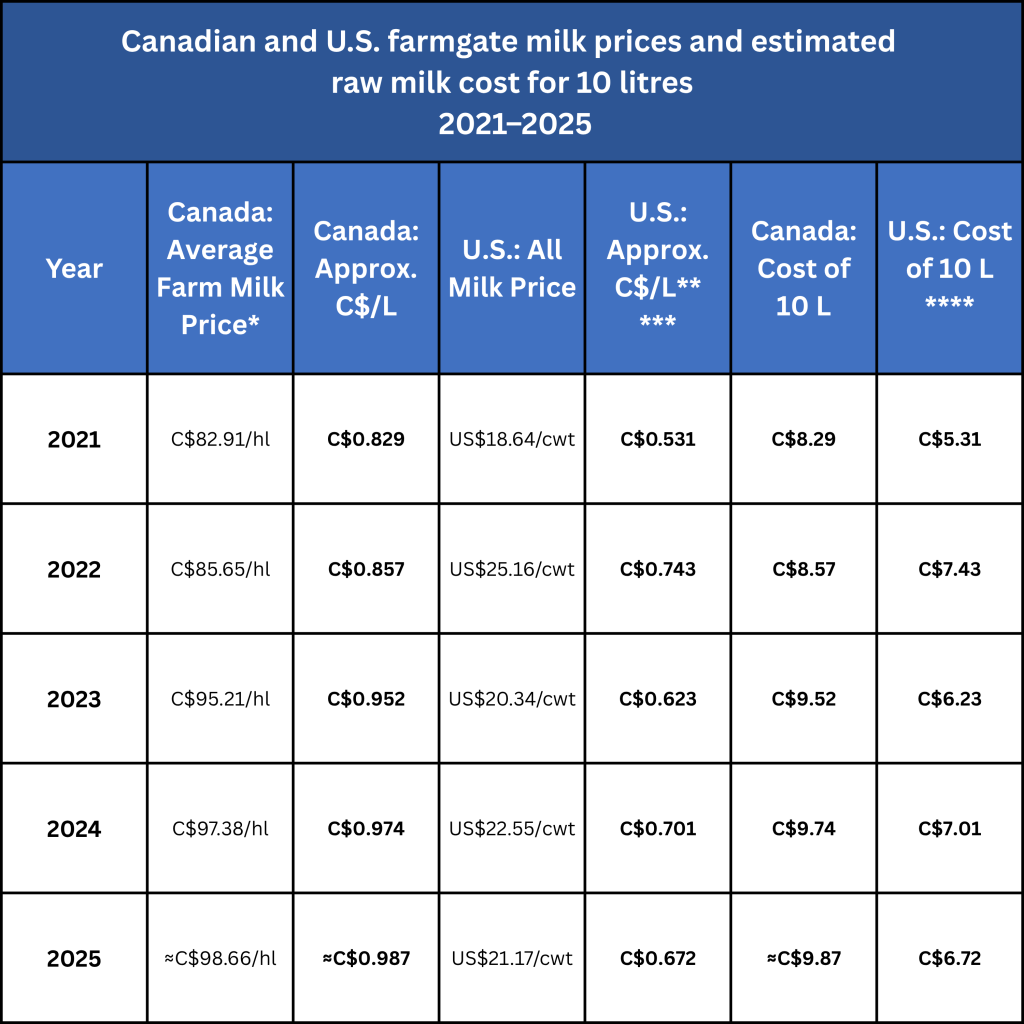
**U.S. prices have been converted to Canadian dollars using the Bank of Canada’s annual average USD/CAD exchange rates: 1.2535 (2021), 1.3013 (2022), 1.3497 (2023), 1.3698 (2024) and 1.3978 (2025). https://www.bankofcanada.ca/rates/exchange/annual-average-exchange-rates/
***U.S. prices reported in dollars per hundredweight (cwt) were converted to litres using 1 cwt = 45.359 kg and an approximate milk density of 1.03 kg/L, equivalent to approximately 44.04 litres per cwt. The resulting U.S. dollar-per-litre figure was then converted to Canadian dollars using the applicable annual exchange rate. https://www.nass.usda.gov/Charts_and_Maps/graphics/data/pricemk.txt
****The 10-litre figures represent the estimated raw milk cost only and do not include processing, labour, transportation, packaging, distribution or other costs.
How Have Milk Prices in Canada and the U.S. Compared in Recent Years?
Recent retail data provides a useful way to see whether the price difference between Canadian and American milk has persisted. Using annual averages from official Canadian and U.S. sources, and converting the U.S. figures into Canadian dollars and a common volume measure, the comparison shows that U.S. consumers have generally paid less for milk than Canadians over the past five years.
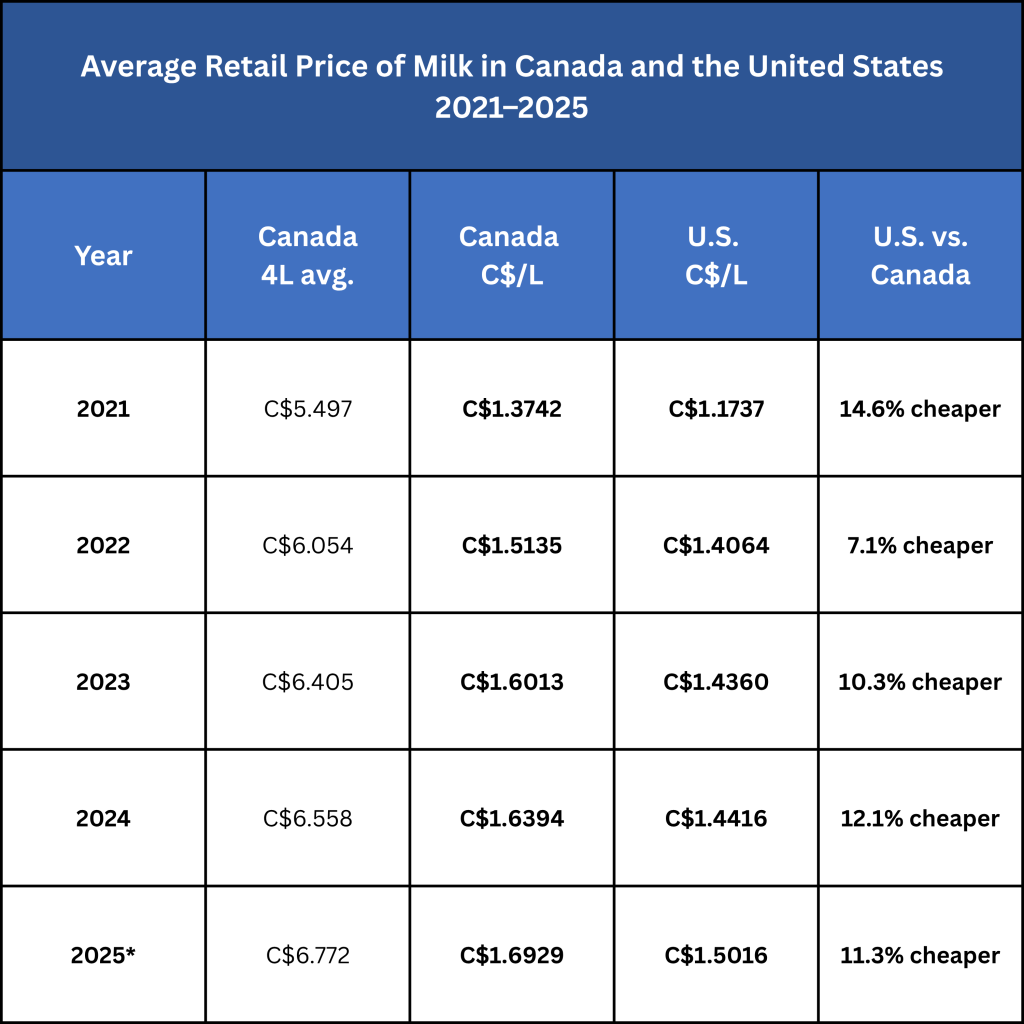
*U.S. 2025 data excludes October because no price was reported for that month.
Recent Policy Changes and Their Effects
Within the last decade, international trade agreements have continued to shape the environment in which Canada’s dairy supply management operates. Deals, such as the Comprehensive and Progressive Agreement for Trans-Pacific Partnership (CPTPP) and the Canada-United States-Mexico Agreement (CUSMA) required Canada to provide greater market access to foreign dairy products through tariff-rate quotas, which allow specified volumes of imported dairy to enter at reduced or zero tariff rates. These concessions have gradually increased the amount of foreign milk proteins, cheese, and other dairy goods available to Canadian processors and retailers, intensifying competitive pressures on domestic producers who previously benefited from tighter import protections.
READ: Next-Generation Strategies for Healthy Cattle Hooves
At the same time, Canada maintains prohibitively high out-of-quota tariff rates — in some cases reaching 200 to 300 percent — on dairy products that exceed negotiated tariff-rate quota (TRQ) volumes. In practice, these rates effectively discourage large-scale imports beyond the agreed access limits. The United States likewise applies elevated tariffs on dairy imports that fall outside its own quota commitments, meaning that only products entering within established TRQs qualify for low or zero-duty access. As a result, while trade agreements have created defined channels for foreign competition, substantial tariff barriers remain beyond those thresholds, reflecting the continuing balance between protecting domestic dairy policy frameworks and meeting international market access obligations.
In 2022, the CDC faced scrutiny over its milk-pricing process, including concerns about the transparency of its consultations and the potential impact of price increases on consumers. The episode also highlighted ongoing questions about the transparency and flexibility of Canada’s milk-pricing framework.
The current Canada-U.S. trade dispute has added another layer to the debate. The first six-year joint review of CUSMA took place on July 1, 2026, with U.S. concerns over Canada’s administration of dairy TRQs remaining a significant trade irritant. At the review, the United States declined to confirm renewal of CUSMA for a further 16-year term, while Canada and Mexico both indicated they wished to extend it. This does not terminate the agreement, which remains in force under its existing term until 2036, but it shifts CUSMA into a cycle of annual joint reviews rather than the next scheduled check-in occurring in 2032, keeping dairy market access as a recurring point of negotiation. The United States has continued to press Canada over access to its protected dairy market, while Canada has maintained that its supply-management system must be defended. At the same time, Canadian law now prevents future trade agreements from increasing TRQs or reducing tariffs on dairy, poultry and eggs, potentially limiting Canada’s ability to offer additional market access in future negotiations. This protection, originally proposed as Bill C-282, died on the order paper when Parliament was prorogued in early 2025; an identical bill, Bill C-202, was reintroduced and received Royal Assent on June 26, 2025.
The dispute has also moved beyond negotiations. In August 2026, the United States imposed a 50 percent tariff on certain Canadian dairy products and other goods under Section 338, while Canada announced matching counter-tariffs on selected U.S. imports, including dairy products, effective September 8. These measures add another layer of uncertainty for an industry already facing questions about how much protection domestic producers should receive and how much Canadian consumers should pay for that protection.
Environmental Measures
Environmental and regulatory trends are increasingly influencing the economics of Canadian dairy farming. Under Canada’s strengthened climate plan, the federal government has committed to reducing methane emissions from the agricultural sector, targeting significant cuts over the coming decade. While these measures are aimed at lowering the sector’s environmental footprint, they also carry implications for dairy producers who may face new compliance requirements, infrastructure upgrades, or shifts in herd management practices.
The added costs associated with implementing methane-reducing technologies and practices have sparked discussion about how the financial responsibility should be shared across the supply chain. Farmers, processors, and ultimately consumers are all part of that equation, and determining who absorbs which costs has become a central aspect of policy and industry dialogue. These evolving environmental expectations, while important for long-term sustainability, can introduce additional complexity to farm profitability and a dairy’s competitive position within both domestic and international markets.
The Case For and Against Deregulation
Proponents of deregulation argue that moving to a market-based system would reduce barriers to entry, encourage competition, and push prices closer to global norms, potentially benefiting consumers and making the industry more dynamic. They point to models like Australia’s, where deregulation encouraged responsiveness to global markets and flexible farm operations.
Opponents argue that supply management stabilizes rural economies, protects family farms from market volatility and ensures food sovereignty. They caution that abrupt deregulation could expose Canadian producers to volatile global commodity cycles and undermine the viability of smaller farms.
Ultimately, the debate about whether the Canadian dairy industry should be deregulated intersects with broader questions of food policy, rural development, trade and consumer protection. Any shift toward deregulation would require careful planning, transitional supports for producers and a nuanced understanding of how global markets operate.
Final Assessment and Ongoing Policy Considerations
The Canadian dairy industry’s governance through supply management has profoundly shaped its structure, economics and stakeholder incentives. Administered through provincial marketing boards, such as the Dairy Farmers of Ontario, and coordinated nationally through the Canadian Dairy Commission and other industry organizations, like the Dairy Farmers of Canada, perhaps the most influential industry lobby shaping policy in its sector, the system links production to domestic demand and supports pricing mechanisms intended to reflect production costs.
Today, there are roughly 9,000 dairy farms operating in Canada — a relatively small and highly regulated producer base. For these farmers, supply management has delivered notable advantages: stable and predictable incomes, insulation from global price volatility and ownership of one of the most valuable agricultural assets in the country — production quota. These quotas can also be leased to other farmers within regulatory limits set by provincial marketing boards. In effect, Canadian dairy farmers operate within a system that offers a level of revenue certainty uncommon in deregulated agricultural markets and society at large. By global standards, they are a fortunate cohort, benefiting from institutional safeguards that reduce risk and enhance asset values that are passed down generations.
At the same time, these advantages for incumbent producers correspond with significant structural barriers to entry. Quota requirements, capital intensity and regulatory limits make it nearly impossible for new or first-generation farmers to enter the industry without substantial financial backing or family succession pathways. In this respect, opportunities are becoming more scarce for individuals who might otherwise pursue dairy farming, but cannot do so because of the regulatory framework. This represents a meaningful disadvantage of the current system, particularly in the context of generational renewal and open-market access.
Comparisons with the United States, Australia, and certain European jurisdictions illustrate the broader trade-offs between regulation and market liberalization. More market-oriented systems tend to offer lower barriers to entry, but greater exposure to price volatility and income instability. Canada’s approach favours stability and asset preservation, but restricts expansion and new participation. Each model carries implications for producers, consumers, rural communities and long-term sector dynamism.
As domestic economic pressures and international trade obligations continue to evolve, the future of supply management — including debates around reform or deregulation — remains an important policy discussion. Affordability of dairy products will always be the focal point for consumers. Given the complexity of the issue and its wide-reaching impact, there should always be room for constructive, evidence-based dialogue that weighs stability against accessibility, and protection against opportunity, in shaping the next chapter of Canadian agriculture.
The weight of the available evidence suggests that Canadian consumers are generally paying higher milk prices than consumers in comparable markets abroad. But there is something even more important. That is the nameless farmer who never had a chance at the prize. That man, woman, husband and wife, brothers and sisters, friends, who were systemically shut out from the late 1960s onward. Even if they failed, they would’ve learned invaluable skills and their farm setup would’ve at least created additional opportunities, such as leasing the land to other dairy farmers, or establishing other permitted uses on the land to generate profit, or even selling the land five to ten years later at a potential profit. But some would’ve surely succeeded, and from their sweat and hard work, they would’ve sprung new generations of farmers that would be around today. But they are forever unknown. That is why it is apt time to once and for all deregulate the Canadian dairy industry.
With dairy quota costs running in the tens of thousands of dollars per cow, is supply management protecting Canadian agriculture or locking out the next generation of young farmers?
Sources
- Adams, S. (2025, December 17). Investing in Ontario Farmland: A complete guide to buying land and farms. Ontario Farms. Retrieved August 30, 2026, from https://ontariofarmsforsale.com/buying-farms-in-ontario-investment-guide-2025
- Agriculture And Agri-Food Canada, Animal Industry Division, Market Information Section & Canadian Dairy Commission. (2025, September 23). Distribution of total milk quota by province. agriculture.canada.ca. Retrieved August 30, 2026, from https://agriculture.canada.ca/en/sector/animal-industry/canadian-dairy-information-centre/statistics-market-information/farm-statistics/distribution-quota
- Agriculture And Agri-Food Canada. (2026, July 27). Dairy sector profile. https://agriculture.canada.ca/. Retrieved August 30, 2026, from https://agriculture.canada.ca/en/sector/animal-industry/canadian-dairy-information-centre/dairy-sector-profile
- Australian Competition and Consumer Commission. (2001, April 9). Big gains to consumers from dairy deregulation. Retrieved August 30, 2026, from https://www.accc.gov.au/media-release/big-gains-to-consumers-from-dairy-deregulation
- Bank of Canada. (2026). Annual exchange rates. Retrieved September 1, 2026, from https://www.bankofcanada.ca/rates/exchange/annual-average-exchange-rates/
- Bothwell Cheese. (2024, June 28). Questions we’re asked. . .frequently – Bothwell Cheese. Retrieved August 31, 2026, from https://www.bothwellcheese.com/questions-were-asked-frequently/
- Dairy Farmers of Canada. (2025). DFC’s quarterly Skim. In Dairy Farmers of Canada. Retrieved August 29, 2026, from https://dairyfarmersofcanada.ca/sites/default/files/2025-05/PLC2510-QuarterlySkimQ1-Spring2025-EN_FINAL.pdf
- Dairy Farmers of Canada. (2026). A day in the life of a Canadian dairy cow | Dairy Farmers of Canada. Retrieved August 30, 2026, from https://dairyfarmersofcanada.ca/en/our-commitments/animal-care/day-in-the-life-dairy-cow
- Dairy Farmers of Ontario. (2024). Dairynomics – Monthly Retail Markets and Production Report. In Dairy Farmers of Ontario. Retrieved August 29, 2026, from https://milkproducer.ca/wp-content/uploads/2024-09-DFO-Markets-Report.pdf
- DFC – PLC. (2025, January 31). The Canadian Dairy Cow Diet. Dairy Farmers of Canada. Retrieved August 30, 2026, from https://dairyfarmersofcanada.ca/en/dairy-in-canada/dairy-excellence/canadian-dairy-cow-diet
- Export Action Global. (2018). Dairy Systems Around the World. In National Farmers Union. National Farmers Union. Retrieved August 30, 2026, from https://www.nfu.ca/wp-content/uploads/2018/05/Dairy-Systems-Around-The-World_Export-Action-Global_April-2018.pdf
- Global Affairs Canada. (2026, June 29). Joint Review of the Canada-United States-Mexico Agreement (CUSMA). GAC. Retrieved August 31, 2026, from https://www.international.gc.ca/trade-commerce/trade-agreements-accords-commerciaux/agr-acc/cusma-aceum/joint-review-examen-conjoint.aspx?lang=eng
- Government of Canada. (2025, December 31). Reducing methane emissions. Retrieved August 29, 2026, from https://www.canada.ca/en/services/environment/weather/climatechange/climate-plan/reducing-methane-emissions.html
- Government of Canada, Statistics Canada. (2026, August 5). Add/Remove data – Monthly average retail prices for selected products. https://www150.statcan.gc.ca/t1/tbl1/en/cv!recreate.action?pid=1810024501&selectedNodeIds=2D13,2D14,2D15&checkedLevels=0D1&refPeriods=20180501,20260101&dimensionLayouts=layout2,layout3,layout2&vectorDisplay=false
- Heminthavong, K. & Library of Parliament. (2018). Canada’s supply management system. In Library of Parliament Background Papers (No. 2018-42-E). Library of Parliament. Retrieved August 30, 2026, from https://lop.parl.ca/staticfiles/PublicWebsite/Home/ResearchPublications/BackgroundPapers/PDF/2018-42-e.pdf
- Holland, K., & Holland, J. (2025). The Dairy Industry as a Source of Conflict between Québec and the United States. In Canada and international affairs (pp. 309–334). https://doi.org/10.1007/978-3-031-76113-3_13
- House of Commons of Canada. (2025, June 5). Private Member’s Bill C-202 (45-1) – Third Reading – An Act to amend the Department of Foreign Affairs, Trade and Development Act (supply management) – Parliament of Canada. https://www.parl.ca/. Retrieved August 31, 2026, from https://www.parl.ca/DocumentViewer/en/45-1/bill/C-202/third-reading
- Mark Milke & SecondStreet.org. (2019). Canadian milk prices much higher than in U.S. In Second Street. Retrieved March 14, 2026, from https://secondstreet.org/wp-content/uploads/2019/10/Policy-Brief-%E2%80%93-Supply-Management-Final.pdf
- Paul, C. (2025, October 27). Farmgate milk prices to be increased | Canadian Dairy Commission. https://www.cdc-ccl.ca/. Retrieved August 31, 2026, from https://www.cdc-ccl.ca/en/node/894
- Slater, S. (2023, July 24). Livestock producers see relief on feed prices. Farmtario. Retrieved August 30, 2026, from https://farmtario.com/livestock/livestock-producers-see-relief-on-feed-prices/
- Trump, J. (2026, August 19). Temporary Suspension of Additional Duties to Offset Canadian Discrimination Against the Commerce of the United States with Respect to Alcoholic Beverages, Dairy, and Motor Vehicles. The White House. Retrieved August 31, 2026, from https://www.whitehouse.gov/presidential-actions/2026/08/temporary-suspension-of-additional-duties-to-offset-canadian-discrimination-against-the-commerce-of-the-united-states-with-respect-to-alcoholic-beverages-dairy-and-motor-vehicles/
- USDA – National Agricultural Statistics Service. (2026, August 31). USDA – National Agricultural Statistics Service – Charts and maps – Prices received: Milk prices received by month, US. https://www.nass.usda.gov/. Retrieved August 31, 2026, from https://www.nass.usda.gov/Charts_and_Maps/Agricultural_Prices/pricemk.php
- U.S. Bureau of Labor Statistics. (2026, August 31). Average Price: Milk, Fresh, Whole, Fortified (Cost per Gallon/3.8 Liters) in U.S. City Average (APU0000709112). FRED. Retrieved August 31, 2026, from https://fred.stlouisfed.org/series/APU0000709112