
California is synonymous with almonds. An astounding 100 percent of almonds exported from the U.S and nearly 80 percent of the world’s almonds come from the fertile valleys of the Golden State, where the combination of a mediterranean climate, deep soil, and a long growing season has created a global powerhouse in tree nut production. Over the past several decades, the almond industry has grown from a regional agricultural staple into a multi-billion-dollar global enterprise, shaping the state’s economy and agricultural policies. Yet beneath this veneer of success lies a complex narrative of environmental stress, corporate consolidation, water shortages and international pressures that threaten to reshape the industry in profound ways.
Origins
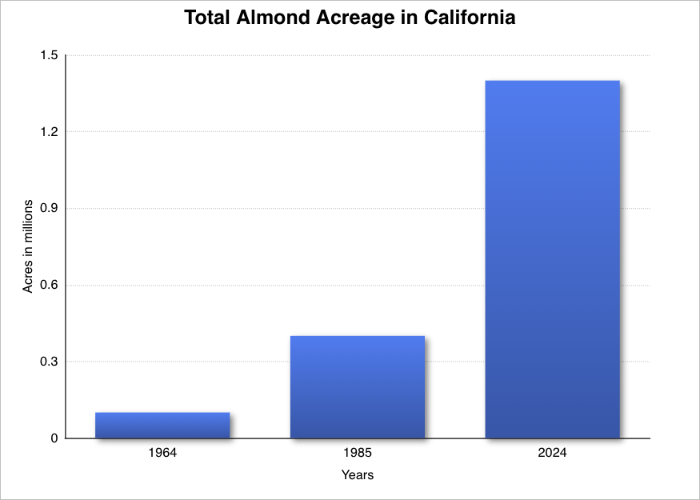
Almond trees first arrived in California in the late 1700s, introduced by Spanish missionaries, but they remained a minor and largely localized crop for many generations. It wasn’t until the decades after World War II that almonds began to shift from small-scale orchards into an industrial agricultural staple. By the 1980s, California had overtaken all other regions to become the world’s dominant almond producer, with large plantings spreading across the Central Valley—specifically the San Joaquin, Fresno, and Sacramento Valleys. This expansion was driven by improvements in irrigation infrastructure, mechanical harvesting, and orchard management, alongside advances in plant breeding and grafting. At the same time, rising international demand — particularly from European and Asian markets — helped reposition almonds as a high-value export commodity rather than a regional specialty crop.
READ: Why Rice Remains the Backbone of Bangladesh’s Rural Economy
Over the following decades, almond acreage continued to climb, reaching roughly 1.38 million acres statewide by 2024. Almonds have since emphasized their economic importance, surpassing other major tree nuts, such as walnuts and pistachios in total value. The crop’s profitability drew significant corporate and institutional investment, reshaping much of the Central Valley into a landscape heavily oriented around almond production. Fresno County alone contributes just over a fifth of California’s total output, underscoring the industry’s geographic concentration. Among the leading varieties are Nonpareil, Monterey, Carmel, and Butte/Padre, with Nonpareil standing apart as the industry benchmark. First introduced in 1879 by A.T. Hatch in Suisun, California, Nonpareil remains the most widely planted and commercially influential almond variety in the state accounting for 40 percent of the total acreage in 2025.
Corporate Consolidation and Industry Players
As the almond industry expanded, corporate consolidation transformed the market, now dominated by a few major players, including Blue Diamond Growers, the Wonderful Company, and other cooperatives and vertically integrated firms. Blue Diamond, a cooperative of over 3,000 growers, controls a substantial share of almond processing and marketing in the United States, while the Wonderful Company, led by Stewart and Lynda Resnick, continues to expand almond acreage and global distribution through its Paramount Farming operation, which manages more than 125,000 acres of almonds and pistachios. Other key participants include Olam Food Ingredients (ofi) — which oversees approximately 50,000 acres and acquired Hughson Nut Inc. (one of California’s top almond processors) in 2019 — and Harris Woolf California Almonds, a major processor connecting growers to international markets.
Pivotal figures such as Richard S. Sykes, former CEO of Blue Diamond, helped drive export expansion and cooperative consolidation in the 1980s and 1990s, while the California Almond Board supports the industry through research, marketing and policy advocacy. Together, these individuals and organizations, along with state and federal governments, shape production practices, marketing strategies, and policy discussions around water, land use, and global trade, influencing thousands of growers and millions of acres of farmland across California.
This consolidation has had both benefits and drawbacks. On one hand, large-scale operations have allowed for efficiency gains, standardized quality and global market penetration. On the other hand, smaller growers often struggle to compete with the economies of scale enjoyed by these corporate giants. Critics argue that consolidation has contributed to pricing pressures, reduced diversity in crop types, and a concentration of water and land resources among a limited number of actors. According to the 2022 Almond Almanac, there are approximately 7,600 almond farmers in California, with 90 percent of them being family-owned and operated. Around 70 percent of these rest on 100 acres or less, while a little over 50 percent rest on between 1 to 49 acres.
Water Shortages and Environmental Pressures
Perhaps the most pressing challenge facing the almond industry is water. Almonds are a water-intensive crop, requiring approximately one gallon of water per almond produced. In California’s arid climate, this translates into massive irrigation demands. The issue is compounded by state policies, climatic variability and ecological pressures.
California’s water system is highly managed. Snowmelt from the Sierra Nevada Mountains historically replenished rivers and reservoirs that support both agriculture and urban populations. However, significant portions of mountain runoff are now diverted for environmental purposes, including the protection of salmon and other endangered species. This means that less water reaches farms during critical growing periods. Simultaneously, the removal and destruction of dams, whether for safety or ecological restoration, further limits water storage capacity. Erratic climate has exacerbated the problem, with less predictable rainfall and more frequent droughts, which makes the need for proper water retention management all the more important.
READ: Land, Law and Legacy: Agricultural Differences in Upper and Lower Canada
Under Governor Gavin Newsom, California has increasingly oriented its water policy toward the recovery of salmon populations and the protection of aquatic ecosystems. In January 2024, Newsom unveiled the California Salmon Strategy for a Hotter, Drier Future, a statewide framework aimed at reversing long-term declines in wild salmon. The strategy prioritizes reconnecting rivers by improving fish passage, restoring degraded habitat and maintaining ecological stream flows in critical watersheds.
As part of this approach, the administration backed major dam removal and modification efforts to reopen historic spawning grounds that had been inaccessible for decades. The dismantling of four dams on the Klamath River — J.C. Boyle, Copco No. 1, Copco No. 2, and Iron Gate — was intended to restore access to roughly 400 miles of habitat. Supported by tribal governments, environmental organizations, and state authorities, the project became the largest river restoration initiative in U.S. history and was completed in late 2024. Total project costs were estimated at approximately $450 million, with $200 million funded by PacifiCorp utility ratepayers, $250 million from California’s Proposition 1 water bond, and an additional $45 million committed as contingency funding by California, Oregon, and PacifiCorp.
The four dams, which functioned as water storage reservoirs, had the following capacities:
Copco No. 1: ~ 42 billion to ~74 billion litres (max. capacity)
Copco No. 2: Negligible storage, serving mainly as a diversion dam
Iron Gate Reservoir: ~73 billion litres
J.C. Boyle Reservoir: ~4.3 billion litres
Total removed storage: Approximately 151 billion litres of potential reservoir water (using Copco No. .1 maximum capacity).
At the same time, Newsom’s water agenda has not been limited to environmental restoration alone. In early 2025, he issued an executive order directing state agencies to intensify efforts to capture and store stormwater from atmospheric river events. The order focused on maximizing use of reservoirs and groundwater recharge systems to improve drought resilience while supporting water supplies for both agricultural producers and local communities.
Has there been any progress since Newsom issued that executive order? In May, as part of the state budget process, Newsom proposed fast‑tracking critical water infrastructure, specifically the Delta Conveyance Project, a roughly 45-mile underground conveyance tunnel intended to improve State Water Project reliability and capture high flows, with estimated costs near $20 billion. This proposal sought to simplify permitting, clarify funding authority and reduce litigation delays — all designed to accelerate construction of a major new water conveyance system that would help capture and move water during high‑flow events to where it’s needed statewide.
In August, the Delta Conveyance Project was identified as the most effective step to ensure reliable water deliveries under hotter, drier conditions. That same month, the state introduced an Accountability Action Plan with a $200 million community benefits fund and measures to engage local communities, marking a major step toward managing both the project’s impacts and its role in capturing and storing high flows.
By October, two concrete milestones helped advance the Delta Conveyance Project: the Department of Water Resources (DWR) submitted a “certification of consistency” with the state’s Delta Plan to the Delta Stewardship Council (a key regulatory requirement), and a state appellate court cleared the way for pre‑construction geotechnical work to resume by reversing a preliminary injunction that had blocked it. These moves represent meaningful forward motion from planning toward potential construction.
During drought years, almond growers have had to make difficult decisions. Some orchards are fallowed temporarily, while others rely on groundwater pumping, which is not sustainable at current rates. These water shortages have created tension between environmental groups, state regulators and the agricultural sector. Almonds have become a symbol of the broader water debate in California, criticized by some as an example of water-intensive crops in an already stressed ecosystem.
Price Changes and Market Dynamics
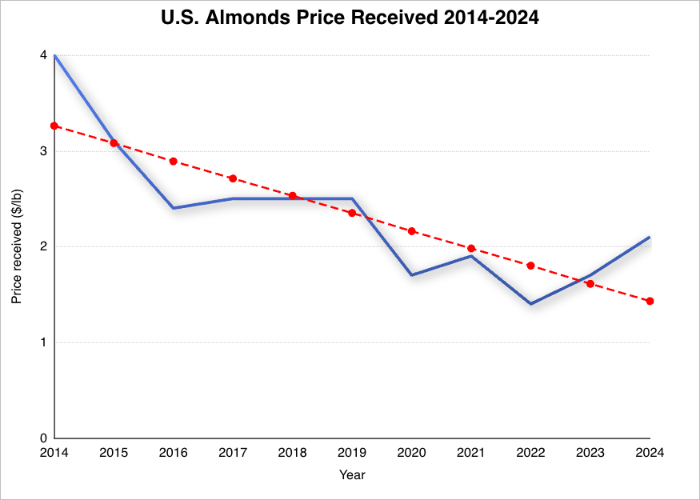
The global demand for almonds has helped maintain high prices, but the industry has seen volatility due to various factors. International competition from Spain, Australia, and other emerging markets puts downward pressure on prices. Weather events, water restrictions and droughts can sharply affect California yields, leading to sudden swings in global supply and price.
Historically, almond prices have been strong because of the fruit’s global reputation for health benefits, versatility in culinary applications and long shelf life. Yet corporate consolidation and large-scale production can amplify market fluctuations: oversupply depresses prices, while shortfalls due to drought can trigger sudden spikes. Growers are often exposed to these swings without full control over market forces, particularly in a landscape dominated by large cooperatives that set pricing structures for global exports.
International Competition and Export Markets
California remains the global leader in almond production, supplying key markets in Europe, China, India and the Middle East. However, international competition is intensifying. Australia has made significant investments in almond cultivation, incorporating advanced irrigation systems and mechanized farming. Although its overall output is smaller than California’s, Australia’s water management practices appear to be more sustainable and drought-resilient, giving it a notable advantage during dry periods. In Europe, Spain continues to be a traditional almond producer, while South American countries are beginning to explore commercial almond farming. Smaller-scale production also exists in Morocco, Tunisia, Syria and Iran.
Ongoing Environmental and Policy Challenges
The almond industry’s expansion has not been without controversy. Environmental groups highlight the enormous water footprint of almonds, the impact on local aquifers and habitat loss in the Central Valley. State regulators face pressure to balance economic interests with sustainability mandates, such as the Sustainable Groundwater Management Act (SGMA), which limits groundwater overdraft—that is, when water is drawn from underground aquifers at a faster rate than natural replenishment by rain and snow. Policies that divert mountain runoff for environmental purposes, combined with dam removal initiatives, have intensified the challenge for growers.
READ: How Much of Canada Is Actually Farmland?
Some policymakers and activists question whether California can continue to support water-intensive crops like almonds amid recurring droughts and climate change. Others argue that almonds are a vital economic engine, supporting rural communities, exports and thousands of jobs. The debate illustrates the tension between environmental stewardship and agricultural prosperity.
Reconciling Growth with Resource Reality
California’s almond industry reflects both the scale and the limits of modern agriculture. Built over centuries into a globally dominant, multi-billion-dollar sector, it sits at the intersection of climate constraints, water policy, market forces and farming prosperity. While growers have adapted through advances in irrigation, soil science, and farm management, increasing water scarcity, environmental pressures and economic competition continue to test the industry’s long-term sustainability. How almond producers — from large agribusinesses to shrinking family farms — respond to these challenges may offer broader lessons for managing high-value, resource-intensive crops in a changing world.
Sources
- Almond Board of California. (2026). United States. Retrieved March 1, 2026, from https://www.almonds.org/almond-industry/regulatory-and-trade/global-markets-overview/united-states
- Almond Board of California. (2025). Almond Almanac 2025. Retrieved on March 1, 2026, from https://www.almonds.org/sites/default/files/2025-12/Digital-Almanac-2025.pdf (used to verify 2022 Almond Almanac numbers regarding farm sizes under 100 acres. The 2025 version suggests similar numbers)
- Almond Board of California. (2022). ALMOND ALMANAC 2022. Retrieved on March 1, 2026, from https://www.almonds.org/sites/default/files/2023-04/2022_Almanac.pdf
- California Department of Food & Agriculture. (2023). California Agricultural Exports 2023 – 2024. In www.cdfa.ca.gov. Retrieved on March 1, 2026, from https://www.cdfa.ca.gov/Statistics/PDFs/2023-2024_california_agricultural_exports.pdf
- California Salmon Strategy For A Hotter, Drier Future: Restoring Aquatic Ecosystems in the Age of Climate Change CALIFORNIA SALMON STRATEGY FOR A HOTTER, DRIER FUTURE 2. (2024). Retrieved on March 1, 2026, from https://www.gov.ca.gov/wp-content/uploads/2024/01/Salmon-Strategy-for-a-Hotter-Drier-Future.pdf
- Dams of the World. (2025a, February 3). Copco No 1 Dam, California, USA | Info & Map. Dams of the World. Retrieved March 2, 2026, from https://damsoftheworld.com/usa/california/copco-no-1-dam
- Dams of the World. (2025b, February 3). Iron Gate Dam, California, USA | Info & Map. Dams of the World. Retrieved March 2, 2026, from https://damsoftheworld.com/usa/california/iron-gate-dam
- Federal Energy Regulatory Commission Office of Energy Projects Division of Hydropower Administration & Compliance, U.S. Environmental Protection Agency, Region 9, & U.S. Army Corps of Engineers, San Francisco District. (2022, February). Draft Environmental Impact Statement For Hydropower License Surrender and Decommissioning: Lower Klamath Project—FERC Project No. 14803-001 Klamath Hydroelectric Project—FERC Project No. 2082-063 Oregon and California. Federal Energy Regulatory Commission. Retrieved March 2, 2026, from https://www.ferc.gov/sites/default/files/2022-02/P-14803-001%202082-063%20Lower%20Klamath%20Surrender%20DEIS.pdf
- Geisseler, D., & Horwath, W. (2016). Almond Production in California. UCDavis, University of California. Retrieved on March 1, 2026, from https://apps1.cdfa.ca.gov/FertilizerResearch/docs/Almond_Production_CA.pdf
- Little, S. (2023, June 2). Nut-Thins®: the co-op cracker. Blue Diamond. Retrieved March 2, 2026, from https://www.bluediamond.com/blog/nut-thins-the-co-op-cracker
- Newsom, G. (2025, January 31). Governor Newsom issues executive order to help California capture and store more water from upcoming severe storms | Governor of California. Governor of California. Retrieved on March 1, 2026, from https://www.gov.ca.gov/2025/01/31/governor-newsom-issues-executive-order-to-help-california-capture-and-store-more-water-from-upcoming-severe-storms/
- Newsom, G. (2025, May 14). Governor Newsom’s budget calls for fast-track of critical water infrastructure project | Governor of California. Governor of California. Retrieved on March 1, 2026, from https://www.gov.ca.gov/2025/05/14/governor-newsoms-budget-calls-for-fast-track-of-critical-water-infrastructure-project/
- Newsom, G. (2025, August 6). Newsom Administration launches Delta Conveyance Project accountability plan, includes $200 million in funding and support for Delta communities | Governor of California. Governor of California. Retrieved on March 1, 2026, from https://www.gov.ca.gov/2025/08/06/newsom-administration-launches-delta-conveyance-project-accountability-plan-includes-200-million-in-funding-and-support-for-delta-communities/
- Newsom, G. (2025, August 19). Governor Newsom’s Delta Conveyance Project is single most effective action for California’s sustainable water future, study finds | Governor of California. Governor of California. Retrieved on March 1, 2026, from https://www.gov.ca.gov/2025/08/19/governor-newsoms-delta-conveyance-project-is-single-most-effective-action-for-californias-sustainable-water-future-study-finds/
- Newsom, G. (2025, October 23). ICYMI: Governor advances Delta Conveyance Project through two key milestones | Governor of California. Governor of California. Retrieved on March 1, 2026, from https://www.gov.ca.gov/2025/10/23/icymi-governor-advances-delta-conveyance-project-through-two-key-milestones/
- PacifiCorp. (2021, October). Klamath Hydroelectric Settlement Agreement Implementation Report. Retrieved on March 1, 2026, from https://www.pacificorp.com/content/dam/pcorp/documents/en/pacificorp/energy/hydro/klamath-river/khsa-implementation/implementation-plans/2021-10-21_2020-KHSA-Impl-Rpt.pdf
- Petrucci, A. (2015, February 2). Paramount Farming Enters Beekeeping Industry with Acquisition of Headwaters Farm. Wonderful. Retrieved March 2, 2026, from https://www.wonderful.com/press/paramount-farming-enters-beekeeping-industry–1727/
- Teneo. (2022, July 6). ofi supports the plant-based revolution with new almond sustainability targets. Olam Food Ingredients. Retrieved March 2, 2026, from https://www.olamgroup.com/news/all-news/press-release/ofi-supports-the-plant-based-revolution-with-new-almond-sustainability-targets.html
- United States Department of Agriculture & National Agricultural Statistics Service. (2025). 2025 California Almond Objective Measurement Report. In USDA, National Agricultural Statistics Service, Pacific Region. USDA, National Agricultural Statistics Service, Pacific Region. Retrieved on March 1, 2026, from https://www.nass.usda.gov/Statistics_by_State/California/Publications/Specialty_and_Other_Releases/Almond/Objective-Measurement/202507almondOM.pdf
- USDA. (2026). USDA/NASS QuickStats Ad-hoc Query Tool. Usda.gov. Retrieved on March 1, 2026, from https://quickstats.nass.usda.gov/results/8DE251FF-1683-3BC4-83E9-B64173BBC5E0
- USDA. (2026). USDA/NASS QuickStats Ad-hoc Query Tool. Usda.gov. Retrieved on March 1, 2026, from https://quickstats.nass.usda.gov/results/7D0FA14F-6946-3EB6-845A-8BFC199B202C
- USDA/NASS QuickStats ad-hoc query Tool. 2026. Retrieved on March 1, 2026, from https://quickstats.nass.usda.gov/results/8DE251FF-1683-3BC4-83E9-B64173BBC5E0