Japan’s agricultural sector is approaching a critical crossroads. Once central to the country’s rural economy and food security, farming is now under mounting pressure from demographic decline, structural inefficiencies, and environmental stress. Analysts warn that without meaningful reform, Japan risks losing a significant portion of its remaining agricultural capacity within the next decade.
Projections suggest that by 2035, more than 1.3 million hectares of farmland — about one-third of the country’s total — could fall out of production. This looming contraction reflects not a single failure, but a convergence of long-standing challenges that have steadily eroded the viability of farming as a profession.
An Aging Workforce and Disappearing Successors
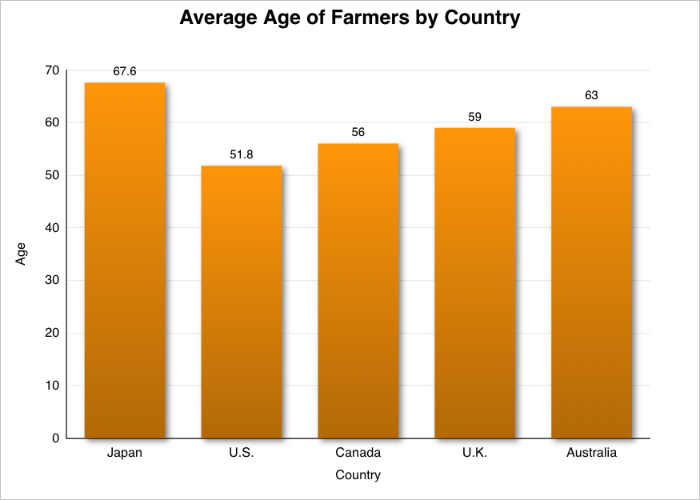
At the heart of the crisis is Japan’s rapidly aging farming population. The average farmer is now over 67 years old, with a substantial share aged 70 and above. For contrast, the average age of farmers in the U.S. and Canada are 58.1 and 56.0 respectively. As younger generations continue to migrate toward urban centres in search of stable incomes and modern lifestyles, few are willing to assume responsibility for family farms. This demographic imbalance has left many rural communities without successors, accelerating land abandonment, and hollowing out entire regions.
Structural Limits of Small-Scale Farming
Japan’s agricultural structure compounds the labour problem. Farming has historically been organized around small, fragmented plots, a legacy of postwar land reforms that prioritized land equity over efficiency. While this model supported rural livelihoods in the past, it now restricts economies of scale, limits mechanization, and raises per-unit production costs. Consolidating land remains slow and administratively complex, preventing the emergence of large, competitive farm operations.
READ: How Much of the U.S. Is Actually Farmland?
Farmland Abandonment on an Unprecedented Scale
As labour shortages intensify, vast areas of farmland are being left idle. In some rural prefectures, 70 to 80 percent of arable land is no longer actively cultivated. Once abandoned, fields are costly to restore, as irrigation systems deteriorate, soil quality declines, and invasive vegetation takes hold. This creates a self-reinforcing cycle in which declining productivity discourages reinvestment.
Falling Food Self-Sufficiency
Japan’s declining production capacity has had clear implications for national food security. The country’s food self-sufficiency rate has fallen from 79 percent in 1960 to 38 percent today, leaving Japan heavily dependent on imports for staples such as grains, feed, and energy. While global trade has masked supply vulnerabilities in normal times, disruptions caused by geopolitics or climate events pose increasing risks to price stability, and availability.
Climate and Environmental Pressures
Rising summer temperatures are already affecting crop quality, and yields. Rice, a cultural and dietary cornerstone, is increasingly vulnerable to heat stress, leading to grain cracking, and downgraded quality. Fruits, dairy and livestock systems are also suffering from heat exposure. Despite these risks, only about 15 percent of Japan’s paddy fields currently use heat-resistant rice varieties, highlighting the slow pace of adaptation.
READ: How India Became the World Leader in Rice Production
Rising Costs and Declining Profitability
Farm profitability has deteriorated sharply in recent years. A weakened yen, combined with high global oil prices, has driven up the cost of imported feed, fertilizers, and machinery. These pressures are particularly acute in livestock sectors, where nearly 60 percent of dairy farmers are operating at a loss. Faced with shrinking margins, many producers are choosing to exit the industry altogether rather than accumulate more debt.
Inefficiencies Beyond the Farm Gate
Even when production succeeds, Japan’s complex distribution and marketing systems frequently erode farmers’ earnings. Layers of intermediaries, regulatory oversight, and cooperative structures often absorb a disproportionate share of revenue, limiting direct market access, and pricing power for producers.
For example, many small and medium producers sell through Japan Agricultural Cooperatives (JA), which aggregates products from hundreds of farms. While this gives farmers access to large buyers, the cooperative takes a share of the profit to cover grading, packaging, storage, and administrative costs. While not uncommon in other nations with cooperatives of their own, for some commodities like rice and mandarins, that collective margin can leave farmers with only a modest portion of the final retail price.
READ: Why Rice Remains the Backbone of Bangladesh’s Rural Economy
Another example are the multiple middlemen in vegetable supply chains. A farmer growing lettuce or spinach may first sell to a local wholesaler, who then sells to a regional distributor before the product reaches a supermarket. Each intermediary adds handling and transportation fees. By the time the lettuce appears on the shelf, the combined markups can be two to three times the price the grower received at the farm gate.
In some regional markets, produce is sold through auction floors where brokers bid on lots. While auctions can help clear inventory quickly, growers often have little control over pricing — especially in seasons with high supply — and brokers can capture the price premium that might otherwise go to producers.
To meet supermarket requirements, farmers may need to sort produce into specific grade categories and use designated packaging. Meeting those standards can increase costs for labour and materials, but supermarkets often pay only minimal premiums for higher grades, leaving farmers to absorb most of the cost burden.
Subsidy Dependence and Structural Stagnation
Government support has helped prevent a rapid collapse of the agricultural sector, but it has also created unintended consequences. Heavy reliance on subsidies has, in some cases, delayed consolidation, and discouraged innovation. This has led critics to describe the sector as “zombified” — kept afloat by public funding rather than sustained productivity or competitiveness.
READ: The Long Rise of California’s Almond Industry
A Narrow Path Forward
Japan’s agricultural future is not predetermined, but the window for reform is narrowing. Addressing labour shortages, accelerating land consolidation, modernizing supply chains, and investing in climate-resilient crops will be essential if farming is to remain viable. Without decisive action, Japan risks losing not only farmland, but also the institutional knowledge and rural communities that have sustained its food system for generations.
Whether Japan can reverse these trends will determine not just the fate of its farmers, but the country’s long-term food security in an increasingly uncertain global landscape.
Sources
- Dairy News Today. “Japan’s Dairy Sector Faces Crisis as Farmer Numbers Drop below 10,000.” Dairynews.today, 2025. Retrieved April 2, 2026, from dairynews.today/news/japan-s-dairy-sector-faces-crisis-as-farmer-numbers-drop-below-10-000.html
- Henriques, Martha. “The Ageing Crisis Threatening Farming.” www.bbc.com, 2019. Retrieved April 2, 2026, from www.bbc.com/future/bespoke/follow-the-food/the-ageing-crisis-threatening-farming/
- Japan Information Network. “Food Self-Sufficiency | Education and Society | Trends in Japan | Web Japan.” Web-Japan.org, 2026. Retrieved April 2, 2026, from web-japan.org/trends00/honbun/tj000604.html
- Lim, Amanda. “Impending Crisis: Japan’s Farmer Exodus Laid Bare in Stark New Data.” AgTechNavigator.com, 16 Sept. 2025. Retrieved April 2, 2026, from www.agtechnavigator.com/Article/2025/09/16/japan-farmland-crisis-one-third-of-farmland-could-be-abandoned-in-10-years/
- Nippon. “Japan’s Rice Farmers Planting More Heat-Resistant Varieties.” Nippon.com, Oct. 2024. Retrieved April 2, 2026, from www.nippon.com/en/japan-data/h02127/
- SHIRATORI, Sakiko. “948. Trends and Outlook of Food Self-Sufficiency Ratio ― toward Revision of the Basic Law on Food, Agriculture and Rural Areas | 国際農研.” Japan International Research Center for Agricultural Sciences | JIRCAS, 30 Jan. 2024. Retrieved April 2, 2026, from www.jircas.go.jp/en/program/proc/blog/20240131
- USDA. “Welcome to Zscaler Directory Authentication.” Usda.gov, 2026. Retrieved April 2, 2026 https://www.nass.usda.gov/Publications/AgCensus/2022/Full_Report/Volume_1,_Chapter_1_US/usv1.pdf
- Whitelaw, Andrew. “FARMER AGE IS JUST a NUMBER, a GROWING ONE – AIRR.” AIRR, 14 Feb. 2023. Retrieved April 2, 2026, from www.airr.com.au/2023/02/15/farmer-age-is-just-a-number-a-growing-one/?srsltid=AfmBOop_cO8A_zM753LRE99mlAuLyOFDUPwYKtSD-HC36XhHzxCtDT8n (In Australia, average age of farmer is determined from those owner/operators of broadacre farms — a large-scale agricultural operation, common in Australia, that focuses on producing crops or livestock across extensive areas of land, typically using mechanized, low-labour methods to grow commodities such as wheat, barley, canola, or raise sheep and cattle)
- Xinhua. “Japan’s Self-Employed Farmers See Record Decline.” News.cn, 2025. Retrieved April 2, 2026, from https://english.news.cn/20251201/e9534f1d6f05454791bcd95d05377d10/c.html