Canada’s agricultural economy is often associated with open markets and global exports, yet a small group of industries operates under a highly controlled system known as supply management. Introduced in the 1970s, this framework governs five specific commodities: dairy, chicken (broilers), turkey, table eggs, and broiler hatching eggs. These sectors are regulated through production quotas, administered pricing, and strict import controls, creating a stable — but highly protected — environment that presents significant barriers for new entrants.
Together, they form a tightly coordinated segment of Canadian agriculture, overseen by national agencies and provincial/territorial marketing boards. Federal agencies, such as Agriculture and Agri-Food Canada, and provincial ones, like the Dairy Farmers of Ontario, often note that these commodities are regulated to ensure production matches domestic demand while stabilizing farmer incomes. Each sector operates under similar rules, but with separate governing bodies. According to government frameworks, production is controlled nationally, while provincial boards allocate quotas to individual farmers.
How the System Works
Supply management is built on three pillars: production control, determining price, and import restrictions. Production is regulated through quotas, which dictate how much a farmer is allowed to produce. Prices are then set based on the cost of production, ensuring farmers receive predictable returns.
READ: Mounting Pressures on Louisiana Farmers
Imports are controlled through tariff-rate quotas (TRQs), which allow a limited amount of foreign product into Canada at low tariffs. Once that threshold is exceeded, tariffs increase dramatically, effectively limiting foreign competition. This structure ensures that domestic supply aligns closely with Canadian consumption. Proponents argue it reduces volatility and shields farmers from global price swings, contributing to economic stability and consistent food supply.
Dairy: The Largest and Most Restrictive Sector
Among the five industries, dairy is the most economically significant and arguably the most difficult to enter. Farmers must purchase quota — essentially the right to produce milk — which is currently capped at $24,000 dollars per 1 kg of butterfat/day in Ontario, Québec, New Brunswick, Nova Scotia and Prince Edward Island. In Western Canada, the cost is even higher, ranging from $35,000 to $57,000 per 1 kg of butterfat/day, depending on the province. Policy research consistently highlights quota costs as a major barrier. High quota prices prevent new farmers from entering the industry altogether, particularly those without substantial capital or family-owned operations. One would need to purchase at least 50 kg of butterfat quota for such a venture to even make sense. Then there’s the array of other costs: cows, milking stations, barn, land, labour, and much more. Because quota is limited and often traded privately, the dairy sector tends to favour established operators, reinforcing consolidation over time.
Poultry and Eggs: Controlled Growth and Limited Access
The chicken, turkey, and egg industries operate under similar constraints. Production quotas determine how many birds or eggs a farm can produce, and entry requires purchasing quota or gaining access through tightly controlled programs. For example, egg production is calculated annually based on projected Canadian demand, with quotas adjusted accordingly. This minimizes surplus, but also limits expansion opportunities for newcomers. Broiler hatching eggs — used to produce chickens — represent a smaller but equally regulated segment, completing the vertically integrated structure of poultry supply management.
READ: Saskatchewan Agriculture 2026: Leading the Way in Canola, Wheat, and Pulses
Turkey Quota
Turkey quota is typically measured in square meters of barn space, or kilograms produced depending on the province. For instance, Québec has capped the price at $500 per square metre and the average number of turkeys per farm is 2,734. The recommended stocking density (SD), as per the National Farm Animal Care Council (NFACC) is between 40 kg/m2 and 65 kg/m2.
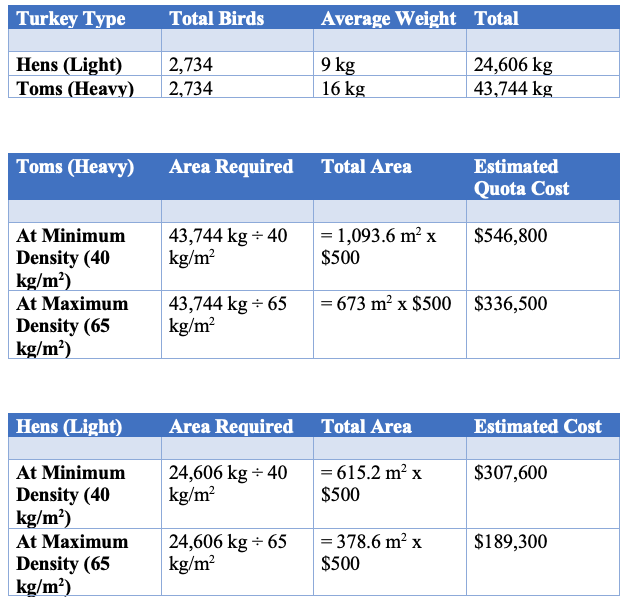
Table Egg (Laying Hen)
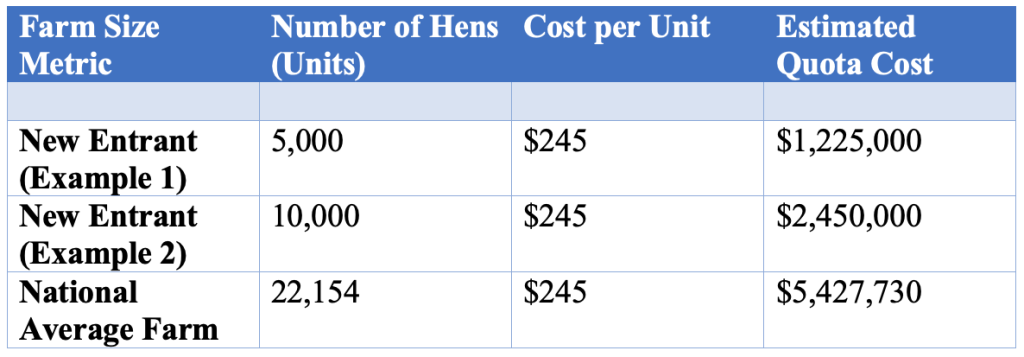
Egg quota is usually measured in number of laying hens (units). Again, using Québec as a reference, the capped price per unit is $245 and an average number of 22,154 hens per farm.
Chicken (Broiler)
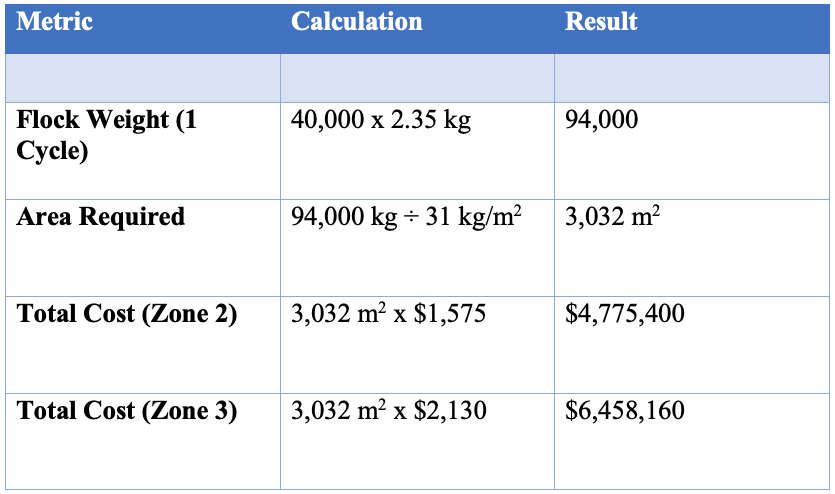
Chicken quota is more complex and varies the most. It is typically measured in kilograms of live weight, or production units (birds per cycle). Industry estimates and provincial exchanges often place values roughly in the range of $1.50 to $3.00 per kg of quota capacity (live weight equivalent; Alberta, Agriculture and Agri-Food Canada), and varies heavily by province and cycle structure. The average farm size (000 kg live weight) in 2020 was 608,000, which totals to roughly 260,000 chickens per year, or around 40,000 per cycle (6.5 cycles per year), with a typical broiler weight in Canada at about 2.35 kg.
READ: How Much of Canada Is Actually Farmland?
Using Québec as an example, broiler quota is divided into geographic zones (three in total) to manage regional production and prevent the over-concentration of farms near major cities. As of a March 9, 2026 auction, Zone 2 Price: $1,575 per m2, and Zone 3 Price: $2,130 per m2, reflecting a unique provincial system where prices fluctuate based on localized demand within these specific areas.
To find the quota cost, we must convert the weight of one cycle of chickens into the required square meters using the standard stocking density of 31 kg/per m2, as recommended by the NFACC.
Broiler Hatching Egg
This is the most niche and specialized segment of the Canadian poultry industry. These farmers raise “breeder” birds that produce the fertile eggs that eventually become the broiler chickens we eat. Hatching egg farms are typically smaller in bird count than broiler or table egg farms because breeder birds require more intensive management.
READ: Why Are Used Tractors So Expensive?
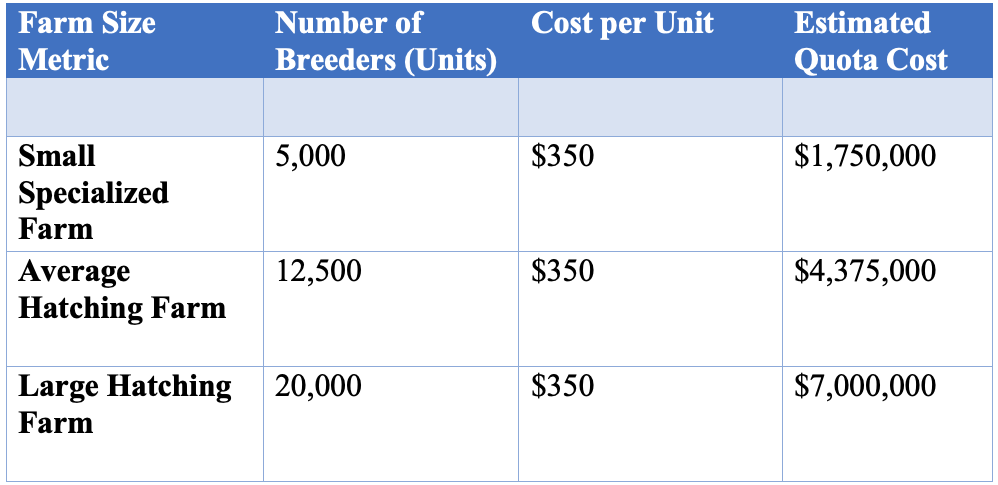
In Canada, the broiler hatching egg industry consists of approximately 237 producers nationwide. An average facility typically houses between 10,000 and 15,000 breeder birds. Quota in this sector consistently trades at a premium compared to table eggs because the revenue per bird is higher, reflecting the value of a fertilized chick over a food product. Consequently, market evaluations and provincial exchanges suggest this quota trades well above the Québec table egg cap of $245 per unit, with estimates ranging between $300 and $450 per bird depending on provincial availability. Using a conservative estimate of $350 per unit, a standard operation requires a significant capital investment in production rights alone.
Why Entry Is So Difficult
The combination of quota costs, regulatory oversight, and limited market access makes these industries among the hardest in Canada for new farmers to enter, if not outright impossible. Unlike most agricultural sectors, where expansion is driven by market demand and entrepreneurial risk, supply-managed sectors require formal permission to produce.
Critics contend that the system disproportionately advantages a limited group of producers, over several generations, while constraining competition and discouraging innovation. It is also frequently cited as a point of contention in international trade negotiations, given Canada’s strict controls on foreign access to these markets. Furthermore, the relatively small number of quota holders compared with the overall farming population underscores the exclusive nature of these supply-managed sectors.
READ: Why Are Idaho Potato Farmers Struggling So Much?
Supporters of supply management emphasize its advantages: stable incomes for farmers, reduced reliance on government subsidies, and consistent domestic food production. The system also supports hundreds of thousands of jobs and contributes significantly to Canada’s GDP. However, these benefits come with trade-offs. High barriers to entry limit generational renewal in farming and restrict opportunities for independent or small-scale producers. The system effectively prioritizes, which supporters often stress, stability over accessibility, creating a controlled agricultural environment unlike most other sectors in the Canadian economy.
Time for Change
Canada’s five supply-managed farming industries — dairy, chicken (broilers), turkey, table eggs, and broiler hatching eggs — have long been promoted as a distinctive agricultural policy designed to balance domestic supply, stabilize prices, and shield producers from market volatility. While this framework has delivered predictable incomes and a consistent food supply, it has also created significant financial and regulatory barriers. The reliance on production quotas and strict import controls means that entry into these sectors is often determined not by skill, innovation, or entrepreneurial ambition, but by access to highly expensive and limited quota — an obstacle that continues to place ownership beyond the reach of most aspiring farmers.
READ: The World’s Most Agriculturally Self-Sufficient Nations
More than half a century after the introduction of supply management, millions of average Canadian men and women have effectively been shut out of these industries. For generations, farming represented not only a livelihood, but also a way of life and a legacy to pass on to future families. Today, the high capital costs associated with quota acquisition have narrowed participation to a relatively small group of established producers and their families, eviscerating any opportunity for new entrants, and reducing generational renewal within the sector. Even with loan programs from the provincial marketing boards, designed to assist potential newcomers in obtaining an initial quota (which has to be given back after a set period), the capital needed is still out of reach for the majority of Canadians, now more than ever.
Supporters of the system frequently emphasize its role in ensuring stability and food security. However, this argument is increasingly debated. Many other Western countries operate successful dairy and poultry industries without quota-based systems, relying instead on open-market mechanisms. These nations have not experienced sudden shortages of essential farm products, suggesting that alternative policy approaches can also sustain reliable domestic production while fostering greater competition and innovation.
The exclusivity of supply-managed agriculture is further illustrated by the relatively small number of farmers involved. Across Canada, there are approximately 9,256 dairy farms, 2,884 chicken (broiler) farms, 1,270 table egg operations, roughly 510 turkey farms, and 237 broiler hatching egg farms, totalling 14,157 producers. In addition to these farmers, the system supports an extensive administrative structure, including around 52* national agencies and provincial/territorial marketing boards, along with their employees. Oversight is provided by the Farm Products Council of Canada (FPCC), which acts as a regulatory referee between federal and provincial authorities to ensure that the system operates within its legal framework. Together, these interconnected institutions, which make up a tiny fraction of the total population, benefit from a model that guarantees a level of employment and income stability not available to the vast majority of Canadians working in other sectors of the economy.
As Canada’s agricultural landscape continues to evolve, questions about fairness, accessibility, and long-term competitiveness are becoming increasingly prominent. While supply management has delivered economic security for those within the system, it has also concentrated opportunity among a limited number of participants. A thoughtful reassessment of this policy could open the door to a more inclusive and dynamic agricultural sector — one that preserves food security while enabling a new generation of Canadians to pursue farming as both a profession and a family legacy.
* Board & Agency Breakdown (Dairy: 10 provincial boards, Chicken: 10 provincial boards, Eggs: 10 provincial + 1 NWT, Turkey: 8 provincial boards, Hatching Eggs: 8 provincial boards, Dairy Farmers of Canada, Chicken Farmers of Canada, Egg Farmers of Canada, Turkey Farmers of Canada, Canadian Hatching Egg Producers)
Is it time for Canada to rethink supply management, or does the system still serve Canadians well?
Sources
- Agriculture and Agri-Food Canada. (2025, August 5). Canada’s chicken industry. agriculture.canada.ca. Retrieved April 9, 2026, from https://agriculture.canada.ca/en/sector/animal-industry/poultry-and-egg-market-information/chicken
- Agriculture and Agri-Food Canada. (2025, August 5). Canada’s hatching eggs industry. agriculture.canada.ca. Retrieved April 9, 2026, from https://agriculture.canada.ca/en/sector/animal-industry/poultry-and-egg-market-information/hatching
- Agriculture and Agri-Food Canada. (2025, December 10). Dairy sector profile. agriculture.canada.ca. Retrieved April 9, 2026, from https://agriculture.canada.ca/en/sector/animal-industry/canadian-dairy-information-centre/dairy-sector-profile
- Agriculture and Agri-Food Canada. (2025, December 15). Canada’s table and processed egg industry. agriculture.canada.ca. Retrieved April 9, 2026, from https://agriculture.canada.ca/en/sector/animal-industry/poultry-and-egg-market-information/table-processed
- Alberta Chicken Producers Recipes and Industry Information. (2026). Alberta chicken producers recipes and industry information. Retrieved April 9, 2026, from https://chicken.ab.ca/chicken-industry/
- Brown, G. (2026). Alberta minimum live price. In chicken.ab.ca. Retrieved April 9, 2026, from https://chicken.ab.ca/wp-content/uploads/2026/01/2026-Period-A-200-FINAL.pdf
- Canadian Hatching Egg Producers. (2026). About – Canadian Broiler Hatching Egg Statistics. chep-poic.ca. Retrieved April 9, 2026, from https://chep-poic.ca/about/
- Dairy Farmers of Ontario. (2025, December 20). Quota and Milk Transportation Policies. Milk.org. Retrieved April 9, 2026, from https://new.milk.org/wp-content/uploads/2025/12/Quota-and-Transportation-Policy-book-2025_December-20.pdf
- Farm Products Council of Canada. (2025, October 14). Supply Management. canada.ca. Retrieved April 9, 2026, from https://www.canada.ca/en/farm-products-council/services/supply-management.html
- Government of Canada; Agriculture and Agri-Food Canada; Market and Industry Services Branch. (2026, April 9). Criteria – 032 Chicken Producer Prices – Agricultural Industry Market Information System (AIMIS). agriculture.canada.ca. Retrieved April 9, 2026, from https://agriculture.canada.ca/en/market-information-system/rp/index-eng.cfm?action=gR&r=23&signature=C3D6DF80F724CA4A9669358335054ACC&pdctc=&pTpl=1#wb-cont
- Government of Canada, Statistics Canada. (2025, December 16). Talking turkey. Statistics Canada. Retrieved April 9, 2026, from https://www.statcan.gc.ca/o1/en/plus/8859-talking-turkey
- Groupe Agéco. (2026, March 9). Poulet – Système centralisé de vente de quota. Retrieved April 9, 2026, from https://groupeageco.ca/poulet/
- Heminthavong, K. (2018, November 30). Canada’s Supply Management System. https://bdp.parl.ca/. Retrieved April 9, 2026, from https://bdp.parl.ca/sites/PublicWebsite/default/en_CA/ResearchPublications/201842E
- National Farm Animal Care Council. (2016). Poultry code of practice. nfacc.ca. Retrieved April 9, 2026, from https://www.nfacc.ca/poultry-code-of-practice#section3
- Pelissero, R. (2022). Egg Farmers of Canada • 2022 Annual Report. In eggfarmers.ca. Retrieved April 9, 2026, from https://www.eggfarmers.ca/wp-content/uploads/2023/03/2022_Egg-Farmers-of-Canada_Annual-Report.pdf
- Provincial Milk Boards and Agencies, & Agriculture and Agri-food Canada, A. I. D., Market Information Section. (2025). Monthly trade of milk quota by province. Retrieved April 9, 2026, from https://agriculture.canada.ca/sites/default/files/documents/2025-05/quota25_e.pdf
- Saskatchewan Chicken. (2025, April 2). Chicken Farm Takes it Full Circle – Chicken Farmers. Chicken Farmers. Retrieved April 9, 2026, from https://saskatchewanchicken.ca/stories/chicken-farm-takes-it-full-circle/
- Turkey Farmers of Canada. (2026). About us. Retrieved April 9, 2026, from https://www.turkeyfarmersofcanada.ca/about-us/